

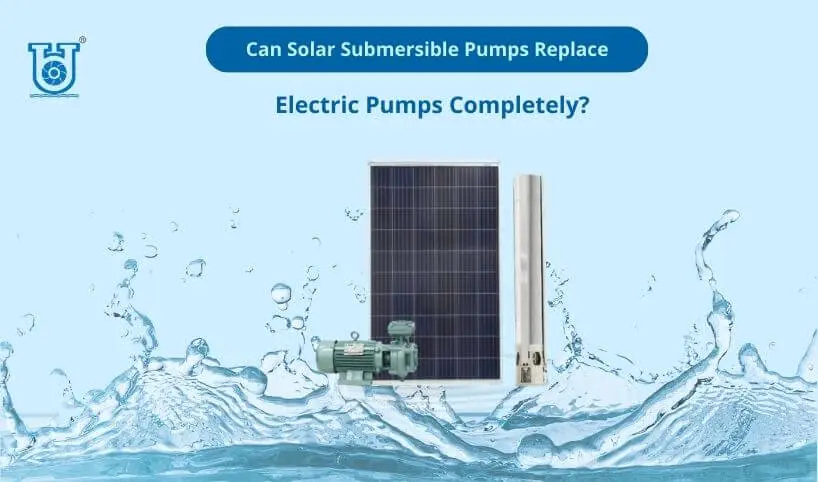
Water pumps are essential for irrigation, water supply, drainage systems, and many industrial applications. Usually, electric pumps have been used in all these places for many decades. Now, solar submersible pumps are increasingly preferred over traditional electric pumps.
Though it is not possible to replace electric pumps with solar submersible pumps everywhere, many factors are responsible for the growing popularity of the latter. Remote areas where electricity is still not easily available, solar pumps act as saviours in irrigation and to remove floodwater.
The rising electricity cost and people’s concern for the environment have contributed to the replacement of electric pumps with solar ones.
Comparison Between Electric Pumps and Solar Submersible Pumps
1. Electric pumps
Electric pumps run on electricity that is available from a grid power supply or diesel generators. These pumps are widely used for water supply by most municipal corporations. Many agricultural firms also use these pumps for irrigating their lands and supplying water to animals. Various industries also need to run these pumps to meet their production requirements.
Pros:
- Reliable where a steady electric supply is available
- High output
- Handle large volumes of water
Cons:
- High operational cost due to the increasing electricity tariffs
- Dependent on the power supply
- High carbon emissions are associated with the use of fossil fuels for electricity generation
2. Solar submersible pumps
Solar submersible pumps draw power from photovoltaic (PV) panels. These pumps are submerged in the water of borewells and reservoirs. These pumps are used in places where sufficient sunlight is available.
Pros:
- Very low operating cost as fuel cost is zero
- Eco-friendly and renewable energy
- Ideal for remote places where grid power is not available
Cons:
- Cannot function if sunlight is not available
- Higher purchase price than electric pumps
- Low output for certain applications
Why Should Electric Pumps Be Replaced With Solar Submersible Pumps?
There are several key reasons why many users are moving away from electric pumps in favour of solar submersible pumps.
Remote places:
Many rural areas and hilly regions still do not receive grid electricity all the time, as we see in urban areas. People living in the villages of those remote areas depend on solar submersible pumps for drawing groundwater. Farmers also depend on the solar pumps to irrigate their lands during the daytime. Hence, all small and medium agricultural firms now use solar submersible pumps, which are located in all sunny regions.
Low operational cost:
Solar submersible pumps run only on solar energy that is drawn from sunlight. So, the expense of buying electricity or fossil fuel is no longer required. It is a major financial benefit for poor farmers and other villagers. The installation of a solar submersible pump is a long-term cost-saver option.
Environmental benefits:
Carbon footprints can be reduced to zero by using solar submersible pumps. No greenhouse gas is emitted while running these pumps. This practice helps in sustainable farming and also in the conservation of fossil fuels.
Better for irrigation and livestock:
Usually, the work of irrigation and feeding farm animals is done during the daytime when sunlight is shining. So, the operation of a solar submersible pump is not a problem unless it is cloudy.
The Challenges Faced By a Solar Submersible Pump
Though solar submersible pumps are quite popular now, some problems are still faced by the users of these pumps.
Dependence on sunlight
As solar submersible pumps function only on sunlight, it is a problem to run these pumps during cloudy days. So, irrigation may face a setback during the monsoon when bright sunlight is hardly available. It is also not possible to operate the pumps at night, unless batteries are attached to these devices.
Limitations in storing solar energy
Solar energy needs to be stored in batteries or hybrid systems to use at night or during cloudy days. This backup process is essential to enable 24-hour availability of solar energy. But it increases the cost of using solar submersible pumps, which may be difficult for many poor farmers to afford. The lifespan of the batteries is limited, further increasing the operational cost of the pumps. The maintenance of the hybrid system is complicated for users, which is an added problem.
Constraint in using on a large-scale
Presently, even the largest solar submersible pump cannot handle a huge volume of water, like electric pumps. So, it is not possible to use solar pumps for high-capacity irrigation projects or large industries where lots of water is needed. These pumps cannot be used also for drawing out water from too deep borewells.
High upfront cost
The high purchase price of a solar submersible pump discourages many poor farmers from buying this device. So, many small firms cannot afford to install solar submersible pumps despite all the advantages. Moreover, the use of batteries for energy storage further increases the total cost of this pump.
Conclusion
Scientists are now researching to eliminate all the problems faced while using a solar submersible pump. However, solar submersible pumps are fast replacing electric pumps in many small and medium agricultural farms for irrigation and watering livestock. These pumps are also useful for water supply in remote areas where grid power is not available.
Many small industries also prefer to use these pumps during the daytime to meet their needs of drawing water. Users need to store water in large tanks to use on cloudy days or at night. For large-scale projects, solar submersible pumps can be paired with grid power, battery, or generator backup to enable continuous operation of the pumps.
Although electric pumps remain necessary in certain cases, solar submersible pumps are increasingly valued for their cost savings, eco-friendly operation, and long-term usability. For many households in rural regions, they provide easier access to water within the home premises, easing the burden of manual water collection.