

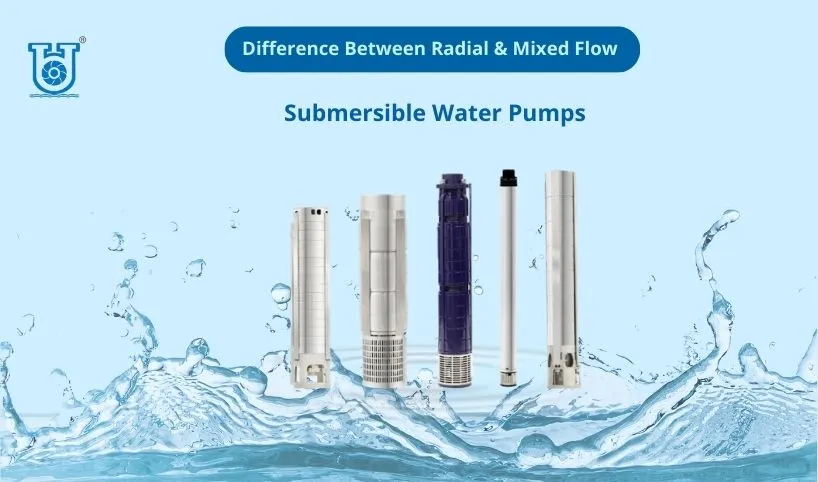
Submersible pumps are useful for irrigation of fields, water supply for domestic use by municipal corporations, industrial applications, and various functions at construction sites. Generally, radial flow submersible pumps and mixed flow submersible pumps are preferred for all these works. Although both categories of pumps are highly efficient, significant differences are noticeable in their basic characteristics, working principles, and common applications. In this article, all the differences between the radial and mixed flow submersible pumps are discussed in detail for the benefit of customers.
What Is A Radial Flow Submersible Pump?
A radial flow pump is designed to make water enter the impeller axially along the shaft and exit radially at a 90-degree angle to the shaft. The impeller throws out water by applying centrifugal force under high pressure.
Key characteristics of a radial flow pump
- High head to lift water to great heights
- Discharge is low to moderate
- Generation of high pressure
- Suitable for all deep borewells
- Multiple impellers are used in a series of different stages
Operating style of a radial flow pump
When the impeller of a radial flow pump rotates, water is pulled into the center or eye of the impeller. Under the action of centrifugal force, water is accelerated to throw towards the periphery with more velocity and pressure. This increased velocity is then converted into usable pressure by diffusers.
Common applications of radial flow pumps
- Water supply from deep borewells
- Domestic water supply in high-rise buildings
- Boost water pressure for industrial applications
- RO plants and water filtration systems
- Water supply schemes in rural areas
A radial flow submersible pump is usually needed to lift water from great depths or to send water to a great height at high pressure. This pump is used where low volumes of clean water are needed to be supplied.
What Is A Mixed Flow Submersible Pump?
A mixed flow submersible pump is a combination of an axial and a radial flow pump. It is designed to make water flow partially axially and partially radially through the impeller. Unlike a radial flow pump, the water is not thrown totally outward. Here, the water travels along a diagonal route to help the pump deliver higher discharge at a moderate head.
Key characteristics of a mixed flow pump
- Medium head to deliver water
- Discharge is higher
- Suitable for drawing water from shallow or moderate depths
- Useful in pumping huge volumes of water
- The number of operating stages is less than that of a radial flow pump
Functioning style of a mixed flow pump
The blades of the impeller are positioned at a suitable angle to allow the water to gain both radial and axial velocity as the impeller rotates. Thus, a perfect balance can be maintained between the moderate pressure and flow rate of the water. The pump operates by applying centrifugal force and lifting action like that of a propeller.
Common applications of mixed flow pumps
- Irrigation of agricultural lands
- Lifting of canal water
- Control of flood situations
- Pumping of sewage water
- Distribution of water supplied by municipalities
- Projects where water needs to be transferred
A mixed flow submersible pump is preferred where a large volume of water needs to be transferred at a relatively lower height. Water transfer from canals, drainage of accumulated floodwater and irrigation can be done by this type of pump.
Notable Differences between a Radial Flow Pump and a Mixed Flow Pump
| Parameter | Radial Flow Pump | Mixed Flow Pump |
|---|---|---|
| Direction of water flow | Perpendicular to shaft (radial) | Combination of radial and axial |
| Head (for pressure) | High head | Medium head |
| Discharge (for flow rate) | Low to moderate | High |
| Suitable depth | Deep borewells | Shallow to medium levels |
| Impeller design | Narrow vanes to create centrifugal force | Angled vanes for dual flow of water |
| Energy efficiency | Efficient for high head | Efficient for pumping high volumes of water |
| Number of stages | Usually multistage | Less number of stages |
| Common applications | High-rise buildings and deep wells | Irrigation of fields, drainage of sewage water and flood control |
Which Submersible Pump Should Be Chosen?
The selection of a radial or mixed flow pump depends on the application requirements of the customer.
A radial flow pump is chosen if –
- The water level is too deep
- Water should be lifted to a great height
- Water pressure is more important than the volume
- Need to supply water to the overhead tanks of tall towers
A mixed flow pump is chosen if –
- Need to pump large volumes of water
- Moderate delivery head
- Use of the pump for irrigation or drainage
- Efficiency at high discharge is the priority
- Radial flow pumps show steep performance curves, which means a slight change in discharge leads to a significant change in head of the pump
- Mixed flow pumps have much flatter curves in performance, showing more stable operation over a wider range of discharge.
If the wrong sort of submersible pump is bought, it may cause poor performance, higher energy consumption, frequent failures of operation and a decrease in pump life.
Differences in Performances of Radial and Mixed flow Pumps
Distinct differences can be noted in the performances of a radial flow pump and a mixed flow pump. These distinctions are highlighted as follows –
Hence, mixed flow pumps are the better choice for applications of frequent fluctuating water levels, like canals or shallow wells.
Conclusion
Radial flow pumps and mixed flow pumps are designed for different hydraulic needs. So, only the right kind of submersible pump should be chosen for a specific operation. If water should be drawn from great depths or sent to high elevations, a radial flow pump is the right choice. If huge volumes of water should be moved to moderate heights, a mixed flow pump should be the ideal choice. The type of head, water flow direction, discharge and applications should be considered to reduce the operating cost and ensure better pump life. A smarter purchase decision can be made by gaining knowledge about both types of submersible pumps.