

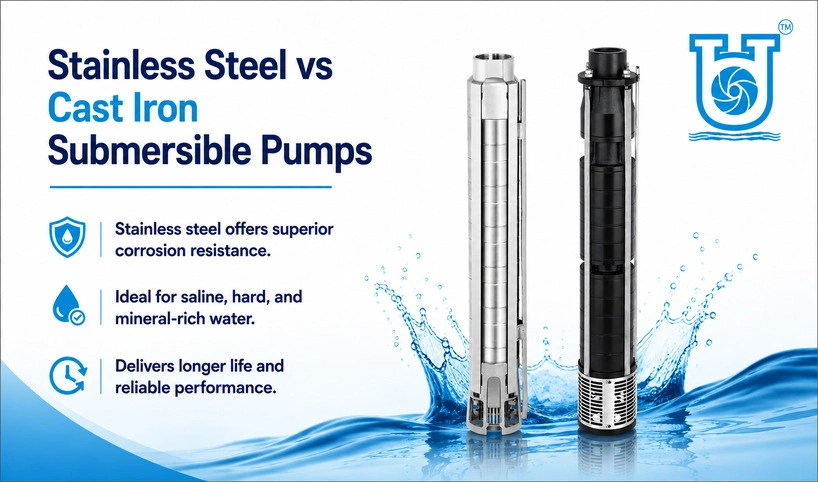
A dealer in Sana’a, Yemen once told a simple story that sums up this whole topic. He had sold the same customer two submersible pumps over three years, both good brands, both correctly sized for the borewell. The first one, built with cast iron parts, started showing rust stains in the discharge water within eighteen months and needed a component swap before year two was out. The second one, stainless steel from top to bottom, was still running clean after three years with no sign of wear. Same well, same water, same depth. The only real difference was the metal.
That story plays out across a lot of markets where groundwater carries more minerals, salts, or acidity than the pump industry’s “standard” test conditions assume. If you’re a distributor, dealer, or OEM buyer sourcing submersible pumps for regions like Egypt, Yemen, Morocco, or Algeria, the choice between stainless steel and cast iron isn’t just a spec on a data sheet. It decides how many service calls you’ll field next year and whether your customers trust your brand the second time around.
This post walks through what actually separates these two materials, where each one makes sense, and what questions to ask before you commit to a bulk order.
Why Material Choice Matters More in Some Markets Than Others
Not every region puts the same stress on a pump. In areas with soft, low-mineral groundwater and moderate temperatures, a well-made cast iron pump can run for years without major issues. But a lot of the territories where submersible pump demand is growing fastest don’t have that kind of easy water.
Coastal and delta regions in Egypt often deal with rising salinity as seawater intrudes into aquifers close to the coast. Parts of Yemen draw from deep wells with naturally high total dissolved solids. Morocco and Algeria both have large stretches of groundwater that run hard, meaning high calcium and mineral content, and in some inland basins, water with a lower pH that behaves more aggressively toward untreated metal. None of this is unusual or rare. It’s simply the water that exists in these regions, and a pump has to work with it every single day, fully submerged, for years at a stretch.
Cast iron doesn’t handle that kind of exposure gracefully. It’s a strong, heavy, load-bearing material, but iron reacts with dissolved salts and minerals over time. The result is rust, pitting, and gradual material loss on the pump housing, impellers, and other wetted parts. In milder water, that process is slow enough to not matter much within a pump’s normal service life. In saline or mineral-heavy water, it speeds up considerably.
What Cast Iron Actually Gets Right
It’s worth being fair to cast iron here, because it’s not a poor material, it’s simply the wrong choice for certain conditions. Cast iron pumps tend to cost less upfront, which matters a great deal in price-sensitive segments of the market. They’re also mechanically strong and good at absorbing vibration, which is a real advantage in heavy-duty industrial or dewatering applications where the water quality is closer to neutral and the priority is raw toughness rather than long-term corrosion resistance.
For inland regions with soft, low-mineral groundwater, and for customers who replace pumps on a shorter cycle anyway due to budget constraints, cast iron can still be a sensible recommendation. The mistake isn’t stocking cast iron. It’s stocking only cast iron and offering it as the default option in markets where the water quality doesn’t suit it.
Where Stainless Steel Pulls Ahead
Stainless steel submersible pumps cost more to manufacture and more to buy, and that extra cost buys three things that matter a lot once a pump is underground and out of sight.
Corrosion resistance. Stainless steel, particularly grades like 304 and 316, forms a thin protective oxide layer on its surface that resists reaction with salts, minerals, and mild acids far better than iron does. In saline or hard water conditions, this is the single biggest factor in how long a pump lasts before performance starts to drop.
Water quality protection. For pumps supplying drinking water or water used in food-related agriculture, corroding metal parts don’t just wear out, they can affect water taste, clarity, and safety over time. Stainless steel doesn’t introduce rust particles or metallic taste into the water supply, which matters for both municipal-style installations and household use.
Longer real-world service life. In the specific water conditions common across Egypt, Yemen, Morocco, and Algeria, a well-built stainless steel pump routinely outlasts a comparable cast iron unit by a significant margin, sometimes by several years. For a distributor, that longer service life becomes a selling point rather than a liability, because a customer who isn’t calling for a replacement pump every eighteen months is a customer who trusts the brand and comes back for the next purchase, whether that’s a second pump, a booster system, or a referral to a neighbor.
There’s a nuance worth mentioning here: not all stainless steel is equal. Grade 304 handles moderate mineral content well and is the more common, more affordable stainless option. Grade 316 includes molybdenum, which gives it noticeably better resistance to chloride and salt exposure, making it the stronger choice for coastal aquifers or any well with elevated salinity. A manufacturer who can’t tell you which grade is used in their pump housing, shaft, and impellers is a manufacturer worth questioning further before you place a bulk order.
Reading the Water Before You Recommend the Pump
A lot of dealers default to whatever pump sells fastest or costs least, without factoring in the specific water conditions of the well it’s going into. That approach works until it doesn’t, and the failures usually show up right around the one to two-year mark, which is exactly when a customer starts forming an opinion about whether they’ll buy from you again.
A more reliable approach is to treat water quality as part of the sizing conversation, right alongside horsepower and flow rate. A few practical signals that point toward stainless steel over cast iron:
- The well is within a few kilometers of a coastline or in a delta region with known seawater intrusion.
- Existing pumps or plumbing fixtures in the area show visible rust or scale build-up within a year or two of installation.
- The water is intended for drinking, food processing, or livestock use, where taste and cleanliness carry extra weight.
- The customer has a documented history of replacing pumps more often than the rated service life would suggest.
- Local water testing, where available, shows elevated chloride, sulfate, or total dissolved solids readings.
None of this requires a lab. Most experienced dealers already have a rough sense of which parts of their territory run hard or saline, simply from years of service calls and customer feedback. Formalizing that knowledge into a stocking and recommendation strategy is what turns it into a business advantage.
Practical Tips for Dealers and Bulk Buyers
Before placing a bulk order or signing on with a new pump manufacturer, a few questions are worth asking directly:
- What stainless steel grade is used, and where? Some manufacturers use stainless steel only for the outer housing while keeping cheaper metals for the impeller or shaft. Ask specifically about each wetted component, not just the shell.
- Is the range available in the bore sizes your market actually needs? Four inch, six inch, eight inch, and ten-inch stainless steel pumps serve very different well types, from household borewells to large agricultural and municipal installations. A narrow range limits how many customer segments you can serve.
- What certifications back the build quality? ISO 9001 and CE certification are reasonable baselines for confirming a consistent manufacturing process, which matters more with stainless steel since the grade and welding quality directly affect corrosion performance.
- Can the manufacturer share real field data or references from similar water conditions? A supplier who has already placed stainless steel pumps successfully in saline or hard water regions similar to yours is a safer bet than one relying purely on lab specifications.
- What’s the price difference in practice, and how does it compare to the cost of a service call? Stainless steel costs more per unit, but if it cuts customer complaints and replacement calls by half, the total cost of ownership often favors it, and that’s a conversation worth having with end customers directly rather than assuming price alone will decide the sale.
Making the Right Call for Your Territory
There’s no single right answer between stainless steel and cast iron that applies everywhere. The right choice depends on what’s actually coming out of the ground in a given territory, and the dealers who take the time to match the material to the water tend to build the kind of reputation that keeps customers coming back instead of shopping around after the first breakdown.
For most of the regions where groundwater runs hard or saline, including large parts of Egypt, Yemen, Morocco, and Algeria, stainless steel is worth the extra cost more often than not. It’s not about upselling for the sake of margin. It’s about recommending a pump that will still be working properly three or four years from now, in the actual water conditions the customer has to deal with every day.
Unnati Pumps has been manufacturing submersible pumps and motors for over 55 years, with a stainless steel range spanning 4, 6, 8, and 10 inch bore sizes, built for exactly the kind of hard and saline water conditions common across these markets. If you’re evaluating suppliers for a new territory or looking to add a stronger corrosion-resistant option to your current lineup, it’s worth reviewing the material specifications closely, not just the price sheet.
Get in touch with the team at Unnati Pumps to discuss grade options, bore sizes, and bulk order terms suited to your region.