

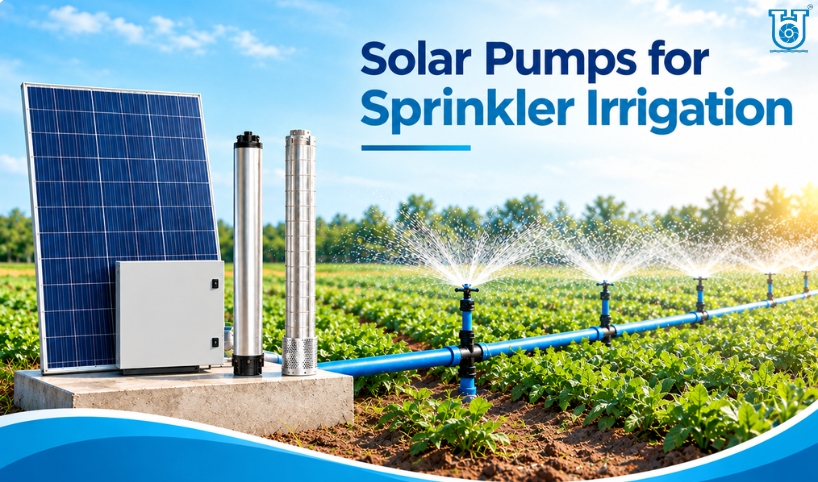
Sprinkler irrigation is widely used for watering crops, gardens, nurseries, and agricultural fields. It distributes water through pipes and sprinkler heads, allowing water to fall over the field much like rainfall.
However, sprinklers need more than just a steady supply of water. They also require enough water pressure to distribute it properly across the required area. This often leads farmers to ask an important question: Can solar pumps be used for sprinkler irrigation?
Yes, solar pumps can be used for sprinkler irrigation. When the pump, solar panels, pipes, and sprinklers are properly sized, a solar pumping system can provide the flow and pressure required to operate sprinklers effectively.
The key is choosing the system according to the water source, irrigation area, required pressure, and daily water demand.
How Does a Solar Pump Work with a Sprinkler Irrigation System?
A solar water pumping system uses energy generated by solar panels to operate a water pump. The pump draws or lifts water from a borewell, open well, pond, tank, or another available water source.
The pumped water then travels through the irrigation pipes to the sprinkler heads.
A typical setup may include:
- Solar panels to generate electricity
- A controller or inverter to manage the power supply
- A solar water pump to move the water
- Main and branch irrigation pipes
- Valves and other control components
- Sprinkler heads to distribute the water
Depending on the water source, farmers can use either a solar submersible pump or a surface solar pump.
For example, a submersible pump may be suitable when groundwater needs to be lifted from a borewell. A surface pump can be considered when water is available from a shallow source such as a pond, canal, tank, or open well.
Why Is Pressure Important for Sprinkler Irrigation?
Pressure is one of the most important factors when using a solar pump for sprinklers.
A sprinkler does not simply need water to reach it. The water must arrive at enough pressure for the sprinkler head to create the required spray pattern.
If the pressure is too low, you may notice:
- Shorter spraying distance
- Uneven water distribution
- Some sprinklers working while others do not
- Dry areas within the field
- Poor irrigation coverage
Using a larger pump does not automatically solve the problem. The complete irrigation system needs to be designed according to the required flow and pressure.
Pipe diameter, pipe length, elevation changes, number of sprinklers, sprinkler type, and water source depth can all affect the pressure available at the sprinkler heads.
How Much Flow Does a Sprinkler System Need?
Flow rate tells you how much water needs to move through the system during a specific period.
Every sprinkler has its own flow requirement. Therefore, the total flow required from the pump depends partly on how many sprinklers will operate at the same time.
For example, running four sprinklers at once usually requires less total water than running twenty sprinklers together.
Before selecting a solar pump, determine:
- Number of sprinklers operating at one time
- Flow requirement of each sprinkler
- Required operating pressure
- Size of the irrigation area
- Available irrigation time per day
This information helps determine the required pump capacity.
For larger farms, dividing the field into irrigation zones can sometimes be more practical than operating every sprinkler at once. Each zone can be irrigated separately, reducing the immediate flow requirement of the system.
Choosing the Right Solar Pump for Sprinkler Irrigation
There is no single solar pump size that works for every sprinkler system. Pump selection should be based on actual site conditions.
1. Check the Water Source
First, identify where the irrigation water comes from.
For deep borewells, a submersible pump is generally used because the pump operates below the water level.
If the water comes from a shallow pond, tank, canal, or similar source, a surface water pump may be suitable depending on the installation conditions.
2. Calculate the Total Head
A pump needs enough head to lift the water and maintain the required pressure throughout the irrigation system.
Total head can be affected by several factors, including:
- Depth of the water source
- Vertical distance water must travel
- Required sprinkler pressure
- Pipe length
- Pipe diameter
- Friction loss through pipes and fittings
- Difference in elevation across the field
This is why selecting a pump only according to horsepower is not recommended.
Two farms using the same number of sprinklers may require different pumps because their borewell depths, field elevations, pipe layouts, and pressure requirements are different.
3. Calculate the Required Flow Rate
The pump should provide enough water for all sprinklers operating within the selected irrigation zone.
If each sprinkler requires a certain flow rate, calculate the combined demand of all sprinklers that will operate simultaneously.
The selected pump should be able to provide this flow at the required total head.
4. Size the Solar Panel Array Correctly
Solar panels need to provide enough power for the pumping system.
The required solar array depends on the pump motor, controller, local sunlight conditions, operating hours, and overall system design.
Solar power also changes during the day. Pump output can therefore vary as solar radiation changes.
A properly designed system takes these variations into account rather than assuming that maximum pump output will remain constant throughout the day.
Can Sprinklers Run Directly from a Solar Pump?
Yes, in a properly designed system, sprinklers can run directly from a solar pump.
However, direct operation means the available flow and pressure may change as sunlight changes. Strong sunlight may allow the pump to operate closer to its expected capacity, while cloudy conditions may reduce the available output.
Another option is to use water storage.
The solar pump can fill a storage tank during sunny hours, and irrigation can then be managed from the stored water. Depending on the design, another pumping arrangement may be needed to create the pressure required by the sprinklers.
Storage can be useful when the preferred irrigation schedule does not match peak sunlight hours.
What Are the Benefits of Using Solar Pumps for Sprinkler Irrigation?
Combining solar pumping with sprinkler irrigation can provide several practical benefits for agricultural applications.
Lower dependence on grid electricity: Solar pumping can be useful for farms in remote areas where electricity supply is unavailable or unreliable.
Reduced fuel use: Farmers who currently depend on diesel-powered pumping can reduce their regular fuel requirements.
Suitable for remote farms: Solar pumping systems can operate in agricultural areas where extending the electricity grid may be difficult or expensive.
Supports planned irrigation: A correctly designed system can supply water to different sprinkler zones according to the farm’s irrigation schedule.
Low operating energy cost: After installation, sunlight provides the primary energy needed to operate the pump.
These benefits make solar-powered irrigation particularly useful in regions with good solar availability and regular agricultural water demand.
What Can Affect the Performance of Solar-Powered Sprinklers?
Even a good solar pump may not deliver the expected irrigation results if other parts of the system are poorly designed.
Common factors that affect performance include undersized pipes, excessive pipe length, clogged sprinkler nozzles, incorrect pump sizing, changes in groundwater level, poor solar panel placement, and operating too many sprinklers at once.
Regular inspection is therefore important.
Solar panels should be kept reasonably clean, sprinkler nozzles should be checked for blockage, and pipes should be inspected for leaks. The pump and controller should also be maintained according to the manufacturer’s recommendations.
Are Solar Pumps Suitable for Large Sprinkler Irrigation Systems?
Solar pumps can support both small and larger irrigation requirements, but system design becomes increasingly important as water demand grows.
A larger field may require greater flow, higher pressure, more solar capacity, larger pipes, or multiple irrigation zones.
Instead of choosing a pump based only on farm size, it is better to calculate the actual water requirement.
Consider how much water the crop needs, how many sprinklers will run together, how long each irrigation zone will operate, and how much water the source can provide.
This approach helps avoid both undersizing and unnecessarily oversizing the system.
Final Thoughts
Solar pumps can be an effective solution for sprinkler irrigation when the complete system is designed correctly. The most important factors are not simply pump horsepower or the number of solar panels. Water source depth, total head, required flow, sprinkler pressure, pipe size, irrigation zones, and available sunlight all need to be considered together.
Correct pump selection can help provide reliable water distribution while reducing dependence on grid electricity and fuel-powered pumping.
Unnati Pumps manufactures solar pumping solutions for agricultural, irrigation, and off-grid water supply applications. Our solar pump range includes submersible and surface pumping solutions for different water sources and operating requirements.
If you are selecting a solar pump for a sprinkler irrigation project, contact the Unnati Pumps team with details about your water source, required flow, head, and irrigation setup to identify a suitable pumping solution.
Frequently Asked Questions
1. Can a solar water pump provide enough pressure for sprinklers?
Yes. A properly selected solar water pump can provide the pressure needed for sprinkler irrigation. The pump must be selected according to the required sprinkler pressure, flow rate, total head, pipe losses, and water source.
2. Can I use a solar submersible pump with sprinklers?
Yes. A solar submersible pump can supply a sprinkler irrigation system when water is being drawn from a borewell or deep well. The pump needs to provide the required flow and pressure at the actual operating head.
3. How many sprinklers can a solar pump run?
There is no fixed number. It depends on the pump’s flow and head performance, the flow requirement of each sprinkler, pipe layout, water source, and available solar power. Sprinklers can also be divided into zones to manage the water demand.
4. Do solar-powered sprinklers work on cloudy days?
They can operate during periods of lower sunlight, but pump output may decrease depending on the solar pumping system and weather conditions. Water storage can help when consistent irrigation timing is required.
5. Do I need batteries for a solar irrigation pump?
Not always. Many agricultural solar pumping systems operate during daylight without batteries. Water can also be pumped into a storage tank during sunny hours for later use.