

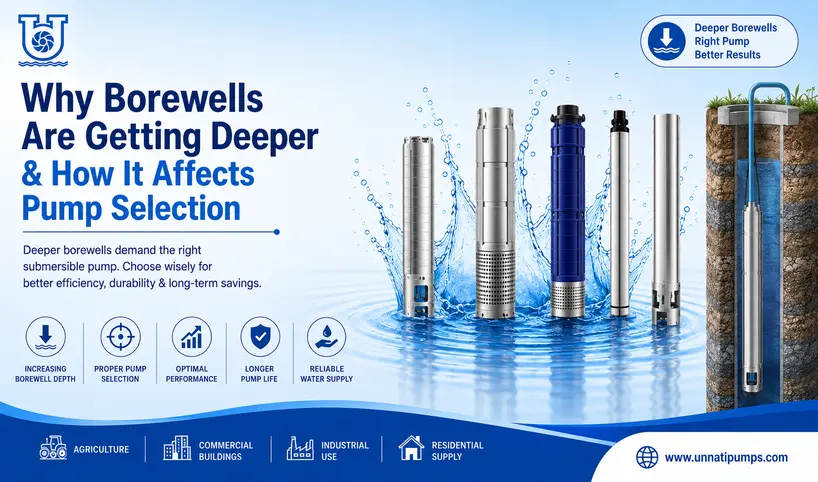
A distributor in Fes, Morocco wrote in last month with a question he had never really had to ask before. His regular customers, mostly farmers with wells drilled ten or fifteen years ago, were suddenly coming back asking for pumps rated for depths those original wells were never designed for. The water simply was not there anymore at the old depth. New wells were being drilled fifty, sometimes eighty meters past where the last one had stopped.
This is not a one-off story. Across Morocco, Algeria, Egypt, and several other markets, groundwater levels have been dropping for years, and the pace has picked up. Farmers keep pumping at the same rate they always have, but the water they are pulling from is sitting further and further underground. For a dealer or OEM buyer, this changes something important: the pump that worked perfectly for a customer’s old well may not be the right choice for the replacement well going in right next door.
This post looks at why wells are getting deeper across these regions, what that actually does to a pump and motor’s job, and what to check before placing your next bulk order so your customers are not stuck with equipment built for water that is no longer where it used to be.
What Is Actually Happening to the Water Table
Groundwater is not an unlimited resource, even though it can feel that way when a well has been reliably producing water for decades. Every time more water is pumped out of an aquifer than rain and natural flow can put back in, the water level inside that aquifer drops a little. Do that year after year, especially during dry stretches, and the drop adds up.
A few things have sped this up in recent years across North Africa and parts of the Middle East. Farming has expanded in areas that used to be left dry, and a lot of that expansion runs on groundwater rather than rivers or canals. Cheaper solar pumps have also played a role in a way that surprises a lot of people: once a farmer switches from a diesel pump to a solar pump, the running cost drops close to zero, so many farmers end up pumping more hours in a day than they used to, simply because it no longer costs them anything extra in fuel. That is good for the farmer’s wallet but tough on the aquifer underneath the field.
On top of that, some regions are seeing less rainfall recharge the ground than they used to, which means less water going back in even as more comes out. Morocco has responded with major investment in desalination and new water storage, and Egypt continues to expand irrigation across reclaimed desert land, both signs that governments in the region are treating groundwater as a resource under real pressure, not an endless supply.
None of this is a reason to panic, and it does not mean wells are running dry everywhere. What it does mean is that a well drilled today, or a replacement pump going into an older well, often needs to reach further down than the original setup did. That single fact changes several things about which pump belongs in the order.
How Depth Changes What a Pump Needs to Do
A submersible pump and motor built for a forty meter well is not automatically fine in an eighty meter well, even if the horsepower rating looks similar on paper. A few things change as depth increases, and each one matters for a dealer trying to avoid a comeback call.
Thrust bearing capacity: The thrust bearing inside a submersible motor is the part that carries the weight of the entire column of water sitting above the pump as it pushes upward. The deeper the well, the heavier that water column gets, and the harder the thrust bearing has to work every single time the pump starts and runs. A motor with a bearing built for shallow wells will wear out faster in a deep one, even if it technically fits.
Cable length and quality: Every extra meter of depth means an extra meter of submersible cable, and that cable has to survive being underwater for years without breaking down. Cheap cable insulation that holds up fine in a forty meter well can start to show problems in an eighty or hundred meter well, simply because there is more length exposed to pressure and more voltage drop to account for over that distance. A dealer supplying a deep well needs to make sure the cable spec matches the depth, not just the pump.
Number of pump stages: Submersible pumps work in stages, small sections stacked inside the pump body that each push water a little further up. A shallow well pump might only need a few stages to do its job. A deep well needs more stages stacked together to build enough pressure to lift water the extra distance. A pump with too few stages for the depth will still run, but it will struggle to deliver the flow rate the customer actually needs, and it will run hotter and wear out faster while trying.
Motor cooling: Submersible motors rely on water flowing past the motor body to keep it cool while it runs. In a well where the water level drops lower during heavy use, which happens more often as aquifers get stressed, there is a real risk of the motor overheating from reduced water flow around it than it was designed for. That is one of the fastest ways to shorten a motor’s life, and it is a risk that grows as water tables fall.
What This Means for Dealers and OEM Buyers Right Now
If you are stocking or distributing submersible pumps in Egypt, Morocco, Algeria, Yemen, or similar markets, the practical takeaway is simple: depth needs to be part of every sizing conversation, not an afterthought. A customer asking for “the same pump as last time” may actually need something different if their new well goes deeper than the old one did.
A few questions worth building into your standard sales conversation:
How deep is the new well, or how much has the water level dropped in the existing one? A lot of customers know this number even if they have not thought to mention it upfront.
Is the customer replacing a pump because it failed, or because the well was redrilled deeper? These call for different recommendations even if the horsepower needs to look similar.
Does your current stock include pumps and motors rated for the deeper end of what your market now needs, not just the depths that were common five or ten years ago?
Are you carrying cable lengths and grades that match your deepest-selling pump models, or are customers being left to source cable separately and risk a mismatch?
Practical Tips for Getting Deep Well Orders Right
A few habits make a real difference here, and none of them require much extra effort once they become routine.
Ask for the static water level and drawdown level, not just the total well depth, whenever a customer can provide it. These two numbers together tell you far more about what the pump will actually face than the well depth alone.
Keep a slightly wider range of stage counts and horsepower options in stock than your market currently seems to need. Water tables move gradually, and a dealer who is already carrying the deeper-rated options avoids scrambling when demand shifts, which it increasingly is across this region.
Double check thrust bearing ratings on any motor before recommending it for well beyond sixty or seventy meters. This is an easy spec to overlook next to horsepower and voltage, but it is one of the first things to fail in a deep well that was matched with the wrong motor.
Talk to your manufacturer directly about depth ratings rather than relying on general catalog numbers. A pump rated for a maximum depth on paper may perform very differently in practice depending on build quality, so it is worth asking for real depth performance data, not just the headline number.
Getting Ahead of a Trend That Is Not Slowing Down
Falling water tables are not a temporary blip in most of the markets where this trend is showing up. They reflect years of increased pumping meeting a slower pace of natural recharge, and the pattern looks set to continue rather than reverse anytime soon. For dealers and OEM buyers, that is less a warning and more a heads up: the pumps and motors that served your market well for the last decade may need an update to match where the water actually sits today.
Unnati Pumps has spent over 55 years building submersible pumps and motors across a wide range of bore sizes, stage counts, and depth ratings, with the thrust bearing capacity and cable options needed for deep well conditions common across Egypt, Morocco, Algeria, and Yemen. If your market’s wells are going deeper than they used to, it is worth reviewing your current stock against where the water table is actually heading rather than where it used to be. Get in touch with the team at unnatipumps.com to talk through depth ratings, stage configurations, and bulk order options suited to your territory.