

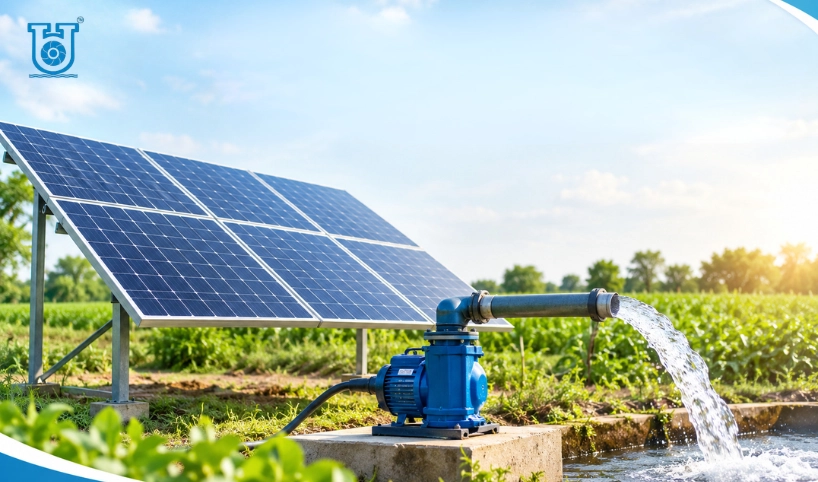
If you are planning to run a water pump using solar energy, one of the first questions you may have is: How many solar panels are needed for a water pump?
There is no single number that works for every pump. The number of solar panels depends on the pump power, solar panel wattage, available sunlight, system efficiency, and how much water you need to pump each day.
For example, a small water pump may need only a few solar panels, while a larger agricultural pump may require a much bigger solar array. This is why solar panel sizing should be based on the actual pump and water requirements rather than a general estimate.
This guide explains the factors involved and shows you how to make a basic calculation.
Quick Answer: How Many Solar Panels Does a Water Pump Need?
To get a basic estimate, you need to know two important values:
- The electrical power required by the pump
- The rated wattage of each solar panel
For example, suppose a pumping system requires approximately 3,000 watts of solar capacity and you plan to use 500 watt solar panels.
3,000 ÷ 500 = 6 solar panels
So, six 500 watt panels would provide 3,000 watts of rated solar capacity.
However, this is only a basic calculation. A real solar pumping system may require additional solar capacity because solar panels do not produce their full rated output throughout the entire day. Temperature, dust, shading, solar radiation, system losses, and equipment efficiency can all affect actual performance.
The final system should therefore be sized using the pump’s electrical specifications and site conditions.
Why Does the Number of Solar Panels Vary?
Two farms using similar water pumps may not always need exactly the same solar array.
This is because solar pumping is a complete system. The pump, motor, solar panels, controller, water source, pipework, and local sunlight conditions all affect its performance.
Before deciding how many panels to install, consider the following factors.
-
Water Pump Power
The pump’s power requirement is one of the main factors in solar panel sizing.
A larger pump generally requires more electrical power and therefore more solar panel capacity.
Do not select the solar array using pump horsepower alone. Two pumps with the same horsepower rating can have different electrical characteristics and operating requirements.
Always check the manufacturer’s specifications for the actual pump and motor.
-
Solar Panel Wattage
Solar panels are available in different power ratings. A higher wattage panel can produce more power under rated test conditions, which can reduce the number of individual panels needed to reach a particular array capacity.
For example, reaching 4,000 watts would theoretically require:
4,000 ÷ 400 = 10 panels
With 500 watt panels:
4,000 ÷ 500 = 8 panels
This does not mean that a higher wattage panel is automatically the best option. Voltage, current, controller compatibility, available installation space, and system design must also be considered.
-
Available Sunlight
Solar panels generate electricity according to the solar energy available at the installation site.
A location with strong sunlight for much of the year may have different system requirements from an area with frequent cloud cover or shorter periods of useful sunlight.
It is also important to understand that daylight hours and peak solar hours are not the same thing. Solar output changes throughout the day and is normally lower in the early morning and late afternoon.
-
Total Water Requirement
A solar pumping system should ultimately be designed around how much water is required.
For agricultural applications, this may depend on the crop, irrigation method, farm size, climate, season, and available water source.
Instead of asking only, “How much power does my pump need?”, it is useful to ask:
-
Pumping Head
Pumping head describes the work the pump must do to move water through the system.
A pump moving water from a deep borewell and delivering it to an elevated storage tank generally has to work against greater head than a pump moving water over a simpler system.
Pipe friction and other system losses also matter.
This is one reason why selecting solar panels based only on the horsepower of the pump can produce an inaccurate result.
How to Calculate Solar Panels for a Water Pump
A simple starting formula is:
Number of solar panels = Required solar array capacity ÷ Wattage of one solar panel
Suppose the designed solar array capacity is 5,000 watts and each solar panel is rated at 500 watts.
5,000 ÷ 500 = 10 panels
The basic result is 10 panels.
However, the required solar array capacity should first be determined from the actual pumping system. It should not simply be assumed to be equal to the pump’s horsepower converted into watts.
The design must account for the motor, controller or inverter where applicable, starting and operating conditions, solar resource, required water output, and system losses.
This is particularly important for a solar submersible pump operating in a borewell or other application where pumping head can be significant.
Can You Calculate Solar Panels from Pump Horsepower?
Horsepower can be useful as an initial reference, but it should not be used alone to determine the final number of solar panels.
One mechanical horsepower is approximately 746 watts. Therefore, you may see simple calculations that convert pump horsepower directly into watts.
For example:
3 HP × 746 watts = 2,238 watts
But this does not mean a 3 HP pump simply needs 2,238 watts of solar panels.
The pump motor requires electrical input, and the complete system has efficiency losses. Solar output also changes according to weather, panel temperature, installation angle, dust, shading, and time of day.
The correct solar array can therefore be larger than a simple horsepower conversion suggests.
Does Pump Type Affect Solar Panel Requirements?
Yes. The type of pump and its application affect system design.
Submersible pumps are commonly used where water must be lifted from borewells or wells. Surface pumps may be used where water is available closer to ground level.
The important point is not simply whether the pump is submersible or surface mounted. You need to consider the required flow, total head, motor characteristics, operating time, and electrical input.
If you are still deciding which pumping system suits your water source, our guide to different types of water pumps and their applications can help you understand the available options.
Can Solar Panels Run a Water Pump Directly?
Yes, some solar pumping systems are designed to operate the pump using electricity generated directly from the solar array through a suitable controller or drive.
In this type of system, pumping performance normally changes with available solar energy. Stronger sunlight can provide more usable energy, while output may reduce during cloudy conditions or at times of lower solar radiation.
Water can also be pumped into a storage tank during sunny periods and stored for later use. In many applications, storing water can be more practical than storing electricity in batteries.
The exact arrangement depends on the pump, controller, water demand, and application.
Can You Add More Solar Panels to Improve Pump Performance?
Adding panels does not automatically mean the pump will deliver more water.
Every pump and controller has operating limits for voltage, current, power, flow, and head. Installing an oversized solar array without considering these limits can result in an unsuitable system.
If additional water is required, first determine why the current system is not meeting demand. The issue could involve insufficient solar capacity, incorrect pump selection, excessive pumping head, pipe losses, low water availability, shading, or another system factor.
For agricultural applications, solar pumping can also be combined with efficient irrigation methods.
Common Mistakes When Sizing Solar Panels for a Water Pump
One common mistake is choosing the number of panels based only on pump horsepower. Horsepower is useful, but it does not describe the complete electrical and hydraulic requirements of the system.
Another mistake is assuming solar panels provide their rated output continuously. Their actual production changes throughout the day.
Shading is another important issue. Even partial shading can reduce the available solar energy.
You should also avoid ignoring the water side of the system. A correctly sized solar array cannot compensate for a pump that is unsuitable for the required flow or head.
Finally, the solar array must be electrically compatible with the pump controller or drive. Panel configuration is therefore just as important as the total wattage.
What Information Is Needed Before Sizing the Solar Array?
Before deciding how many solar panels you need, collect the following information:
- Pump model and power rating
- Motor electrical specifications
- Required daily water volume
- Required flow rate
- Borewell or water source depth
- Static and pumping water levels where applicable
- Delivery height
- Pipe length and diameter
- Solar panel specifications
- Solar conditions at the installation location
- Pump controller or drive specifications
These details allow the pumping system and solar array to be designed together rather than treating them as separate components.
Final Thoughts
So, how many solar panels are needed for a water pump?
The answer depends on much more than pump horsepower. Pump power, panel wattage, solar conditions, daily water demand, pumping head, system efficiency, and controller compatibility all influence the final number.
A simple calculation such as required solar array watts ÷ panel watts can provide an initial estimate. However, the final design should always be based on the complete pumping system.
For farms, borewells, irrigation systems, and other water supply applications, correct sizing helps ensure that the available solar energy and pump performance match the actual water requirement.
Unnati Pumps provides water pumping solutions for agricultural, residential, industrial, and solar applications. Explore our solar pump solutions or contact our team with your pumping requirements to identify a suitable solution for your application.
Frequently Asked Questions
1. How many solar panels are needed for a 1 HP water pump?
There is no fixed number based on 1 HP alone. The correct number depends on the pump’s electrical input, panel wattage, controller requirements, available sunlight, pumping head, and required water output.
2. Can a 500 watt solar panel run a water pump?
It depends on the power requirement and electrical characteristics of the pump. A single 500 watt panel may operate certain small pumping systems, but larger pumps will require more solar capacity.
3. How do I calculate solar panels for my pump?
Start with the required solar array capacity determined for the pumping system. Divide this by the wattage of one panel. Then verify voltage, current, controller compatibility, solar conditions, and system losses before finalising the design.
4. Can I run a borewell pump using solar panels?
Yes. Solar power can be used for suitable borewell pumping systems. The pump and solar array must be selected according to borewell conditions, required flow, pumping head, and electrical requirements.
5. Do solar water pumps need batteries?
Not always. Many systems can pump water when sufficient solar energy is available and store the water in a tank for later use. Whether batteries are appropriate depends on the application and operating requirements.