

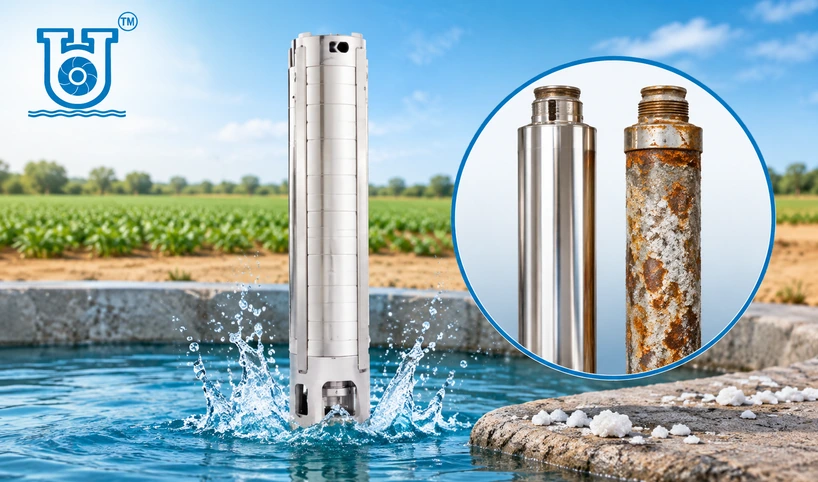
Salty groundwater does not destroy a pump overnight. It works slowly. A small pit forms on a shaft. A bolt head turns to rust. A cast iron bowl loses wall thickness year by year. Then one season the pump loses output, or the shaft snaps, and the pump has to come out of the well far earlier than planned.
Across coastal plains and desert basins in North Africa and the Middle East, more farms and towns are pumping water with high salt content. Choosing a submersible pump for saline water therefore comes down to one question above all: which materials will survive your particular water? This article compares the common pump materials, explains how salt attacks each one, and lists what to check before you place an order.
First, Know What You Are Pumping
“Brackish” and “saline” are not exact terms in everyday use. The US Geological Survey classifies water by its dissolved solids content, which gives a useful common language:
|
Water type |
Total dissolved solids (mg/L) |
|
Fresh |
Less than 1,000 |
|
Slightly saline |
1,000 to 3,000 |
|
Moderately saline |
3,000 to 10,000 |
|
Highly saline |
10,000 to 35,000 |
|
Seawater (typical) |
About 35,000 |
Total dissolved solids alone does not tell the full story, though. For pump materials, these values matter just as much:
- Chloride level, the main driver of pitting in stainless steel
- pH, since acidic water speeds up most forms of corrosion
- Temperature, because corrosion generally gets worse as water gets warmer
- Dissolved oxygen, carbon dioxide and hydrogen sulphide (the gas behind a rotten egg smell)
- Sand and suspended solids, which wear away protective surface layers
A full laboratory analysis is cheap compared with a failed pump. Ask for one before you finalise materials.
How Salt Attacks a Submersible Pump
Salt water causes damage in a few distinct ways. Knowing them explains why some materials do better than others.
General corrosion
The metal surface dissolves fairly evenly. This is typical of cast iron and carbon steel. It is predictable, so designers can allow extra wall thickness, but it still shortens service life in aggressive water.
Pitting and crevice corrosion
Stainless steel resists corrosion because of a thin chromium oxide film on its surface. Chlorides can break this film at weak points, creating small, deep pits. Crevices, such as gaps under washers, behind gaskets or between shaft and sleeve, are especially vulnerable because the water trapped there becomes more aggressive over time. Pumps that sit idle for long periods can suffer more, since stagnant water favours crevice attack.
Galvanic corrosion
When two different metals touch in salty water, they behave like a battery. The less noble metal (often cast iron, carbon steel or zinc coating) corrodes faster than it would alone. A stainless steel pump joined to galvanised pipe, or fitted with ordinary steel fasteners, can create exactly this situation.
Erosion corrosion
Sand-laden water scrubs away the protective layer, exposing fresh metal to attack. Impellers, wear rings and the pump inlet take the worst of it.
Comparing the Main Pump Materials
No material is right for every saline application. The table below gives a general picture. Your water analysis and the manufacturer’s guidance should make the final call.
|
Material |
How it handles salty water |
Typical use |
|
Cast iron |
Prone to general corrosion; life shortens as salinity rises |
Fresh or mildly mineralised water |
|
Stainless steel AISI 304 |
Good general corrosion resistance; vulnerable to pitting as chlorides rise |
Fresh to mildly brackish groundwater |
|
Stainless steel AISI 316 |
Contains about 2 to 3% molybdenum, giving better resistance to chloride pitting than 304 |
Brackish groundwater where 304 is marginal |
|
Duplex and super duplex steels, 904L |
Much higher pitting resistance than 316 |
Highly saline water and seawater, usually in specialist pumps |
|
Engineered thermoplastics such as Noryl |
Do not rust; resist many salts; strength limits apply |
Impellers and diffusers in smaller pumps |
|
NBR rubber |
Generally stable in salt water |
Wear rings, bearing bushes, seals |
Two points are worth stressing. First, 316 is better than 304 in chloride water, but it is not immune. Field reports from very salty boreholes show 316 failing too, where higher alloys or non-metallic parts were needed. Second, a higher grade often costs more, so match the material to the water rather than defaulting to the most expensive option.
For a broader look at the two most common pump bodies, see our comparison of stainless steel vs cast iron submersible pumps.
Look Beyond the Pump Body
Buyers often focus on the bowl and impeller material and forget the rest of the assembly. In salty water, the weakest wetted part sets the service life. Check each of these:
- Pump shaft and coupling. These are thin, highly stressed parts where a small pit can lead to fatigue cracking.
- Motor shell, housings and shaft extension. Some motors combine a stainless steel shell with cast iron end housings. Ask what every wetted motor part is made of.
- Fasteners, cable guards and strainer screws. Mixed metals here can trigger galvanic corrosion.
- Check valve and discharge head.
- Column pipe. Galvanised steel corrodes in salty water, especially at the threads. Many installers switch to uPVC column pipes, which do not corrode.
- Cable joint. The splice between the motor lead and drop cable must be fully watertight. Salt water conducts electricity well, so a weak joint fails quickly.
What Unnati Pumps Offers for This Kind of Water
Unnati’s standard 4, 6, 8 and 10 inch stainless steel submersible pumps are built from AISI 304 stainless steel. On the 8 inch and 10 inch models, the shaft is AISI 431 stainless, the coupling is AISI 316, and the neck rings and bearing bushes are NBR. AISI 316 construction is listed as a special option on request across these ranges.
For smaller bores, the Noryl submersible pumps use engineered thermoplastic hydraulic parts. Whether either option suits your well depends on your water analysis, so share it with our team before ordering. You can browse the full stainless steel submersible pump range for sizes and duties.
Maintenance Habits That Extend Pump Life
Material choice is half the battle. How the pump is run and serviced matters too.
- Avoid long idle periods where possible, or run the pump briefly at intervals so water does not stagnate.
- Log performance. A slow fall in flow or rise in current often signals impeller or wear ring damage.
- Inspect at every pull. Look for pitting on the shaft, coupling and fasteners, and replace small parts before they fail.
- Use matching spares. Replacing a 316 part with a cheaper 304 or carbon steel part creates a weak point.
- Retest the water. Salinity in many aquifers rises over time as pumping draws in deeper or coastal water.
Our older guide on the causes of pump corrosion and how to prevent it covers general prevention steps that apply here as well.
Start With the Water Report
The best material for a saline borehole is the one chosen from real test results, not from a general rule. Send your water analysis, well depth and required duty with your enquiry, and the right combination of pump, motor and pipe materials becomes much easier to pin down.
At Unnati Pumps, we manufacture and supply stainless steel and Noryl submersible pumps and motors for agricultural, residential, and industrial applications. Explore our pump range to find a suitable solution for your brackish and saline groundwater requirements, or contact us with your water analysis, well depth, and required duty, and our team will help you choose the right materials.
Frequently Asked Questions
1. Is AISI 316 stainless steel enough for seawater?
Not always. Many seawater and hypersaline applications call for duplex, super duplex or other higher alloys. Suitability depends on chloride level, temperature and oxygen content, so check with the manufacturer.
2. Can a cast iron pump work in brackish water?
It can run, but its life is likely to be shorter, and corrosion products may affect water quality. Stainless steel or non-metallic parts are usually a better long-term choice once salinity rises.
3. Does salty water affect the motor as well as the pump?
Yes. Every wetted motor part, including the shell, housings and shaft extension, is exposed. The cable splice is another common failure point in saline wells.
4. How often should I test my well water?
At least before buying a pump and whenever performance or taste changes. In aquifers known for rising salinity, an annual test is a sensible habit.
5. Can I use an AISI 304 stainless steel submersible pump in brackish water?
Yes, in many cases. AISI 304 performs well in fresh to mildly brackish groundwater, but it becomes vulnerable to pitting as chloride levels rise. If your water analysis shows high chlorides, AISI 316 or non-metallic hydraulic parts are the safer choice.