

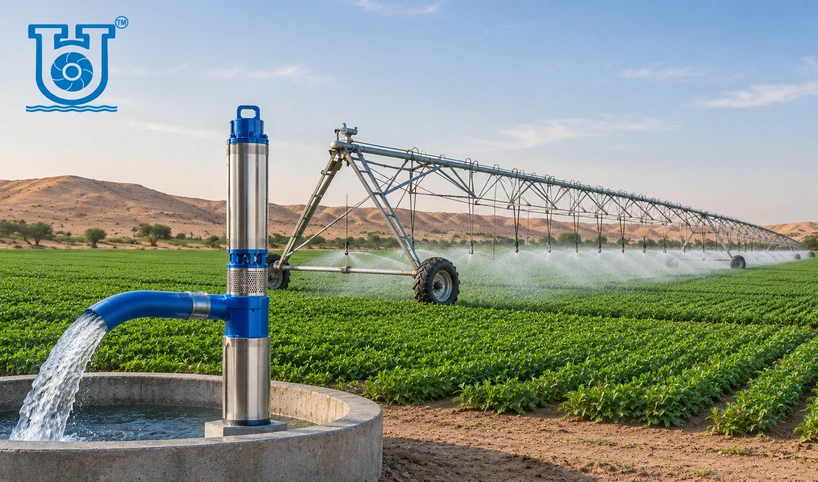
On a desert farm, the center pivot is the part everyone sees: a long steel arm crawling slowly across a green circle in the middle of the sand. The part that decides whether that circle stays green is hidden more than a hundred metres below ground. It is the borehole pump.
Choosing a submersible pump for center pivot irrigation is different from choosing a pump for a tank or a small drip plot. A pivot needs a large, steady flow at a steady pressure, often for 18 to 20 hours a day in the hottest months. On deep Saharan and Middle Eastern aquifers, the pump may lift water from 150 to 250 metres before the pivot even starts. Get the sizing wrong and you either under-water the outer spans or pay for energy you never needed.
This guide walks through how to size and select a borehole pump for a pivot, step by step, with the practical issues that matter on desert farms.
What a Center Pivot Asks of Its Pump
A pivot is designed around two numbers printed on its sprinkler chart:
- Flow rate: the total water the pivot needs, usually in m³/h or litres per second
- Pivot point pressure: the pressure needed at the base of the pivot so that every nozzle, out to the last span, works as designed
Your pump has to deliver both at the same time. If pressure at the pivot point drops below the design figure, the outer spans get less water than the inner ones. Since the outer spans cover most of the circle’s area, low pressure hurts yield more than many farmers expect. University of Nebraska extension specialists have reported that low pressure is a more common problem on pivots than most growers realise, often linked to leaks or a well that cannot keep up with the system.
So the starting point is always the pivot design, not the pump catalogue.
Step 1: Work Out the Flow You Need
If your pivot supplier has given you a design flow, use it. If you are planning a new system, you can estimate it from the field area, the crop’s peak daily water use and how many hours the pivot will run.
Example calculation
These figures are assumptions for illustration only. Your agronomist or irrigation designer should confirm the real values for your crop and location.
- Pivot radius: 400 m, which covers about 50 hectares
- Peak crop water use in summer: 8 mm per day
- Application efficiency: 85%
- Operating time: 20 hours per day (leaving time for maintenance and tower stops)
Net daily water = 50 ha × 10,000 m² × 0.008 m = 4,000 m³ Gross daily water = 4,000 ÷ 0.85 = about 4,700 m³ Required flow = 4,700 ÷ 20 hours = about 235 m³/h
That is a lot of water from one borehole. Many desert wells cannot yield it, which is why some farms split one pivot across two wells, shorten the pivot, or plan crop rotations that ease peak demand.
Step 2: Add Up the Total Head
Total head is the pressure the pump must build, expressed in metres of water. For a pivot, it has several parts:
| Head component | What it covers | Example value |
|---|---|---|
| Pumping water level | Depth to water while the pump is running, not the resting level | 120 m |
| Column pipe friction | Losses inside the rising main at the design flow | 6 m |
| Surface pipeline friction | Losses between wellhead and pivot point | 4 m |
| Elevation | Height difference between wellhead and pivot point | 5 m |
| Pivot point pressure | From the sprinkler chart, for example 2.5 bar | 25.5 m |
| Total dynamic head | about 160 m |
A useful conversion: 1 bar of pressure is roughly 10.2 metres of head.
The biggest mistake here is sizing on the static water level. In desert aquifers, the water level can drop a long way once pumping starts, and it often falls further across the summer and from year to year. Base your figures on a proper pump test and leave a margin for decline. Our article on why head and flow rate matter when choosing a submersible pump explains this in more detail.
Step 3: Match the Pump to the Borehole
Once you know flow and head, three questions narrow down the pump:
Will it fit? Borehole diameter limits pump size. Large pivot flows usually need 8 inch or 10 inch pumps, which in turn need wells of at least that diameter. Unnati’s 8 inch stainless steel submersible pumps, for example, are built for wells of 8 inches (DN200) and above, with mixed flow impellers for higher flow duties.
Will it run near its best efficiency point? Every pump curve has a zone where it uses the least energy per cubic metre. Choose a model whose duty point (your flow and head) sits close to that zone, not at the far end of the curve.
Can the well supply it? A pump that draws more than the aquifer can give will pull the water level down to the intake, causing dry running and damage. The pump test result should set the upper limit on flow.
Building for Desert Conditions
Desert boreholes are hard on equipment. A few points deserve attention when comparing quotations:
- Sand. Fine sand wears impellers, diffusers and bearings. Ask for the maximum sand content each model is rated for. Unnati lists 50 g/m³ for its 8 inch and 10 inch stainless steel pumps.
- Water temperature. Deep aquifers can be warm. Check the motor’s maximum water temperature against your well, and ask whether derating applies.
- Water chemistry. Brackish groundwater is common in desert basins. Get a water analysis before choosing between cast iron and stainless steel construction.
- Motor cooling. A motor smaller than the casing may need a flow sleeve to stay cool.
- Starts per hour. Pivots usually run long cycles, but stop-start operation from pressure switches or generator trips should stay within the motor’s rated starts per hour.
Where Desert Farms Lose Money on Energy
Pumping is often the largest running cost on a pivot farm, whether the energy comes from the grid, diesel or solar. These are the usual places money leaks away:
Excess pressure. Every extra bar at the pivot point means more head and more energy. Low pressure nozzle packages, many of which run between roughly 0.7 and 2 bar according to extension guides, have cut pumping costs on many farms. Change the nozzles and the pump duty changes too, so review both together.
Oversized pumps throttled with valves. A pump running against a partly closed valve wastes energy as heat. If the pump is too big, the better fix is a correctly sized pump or a speed controller.
End guns and corner arms. When the end gun switches on or a corner arm swings out, flow demand rises. A fixed speed pump may then drop below design pressure. A variable speed drive with pressure control can help, as long as motor cooling and the pump’s minimum flow are respected at low speed. Discuss the right control panel and protection for your setup with your supplier.
Worn pumps. Impeller wear slowly reduces output. Recording flow, pressure and current at the start of each season shows when performance has slipped.
Quick Buyer’s Checklist
Before you ask for quotes, gather this information:
- Pivot sprinkler chart showing design flow and pivot point pressure
- Recent pump test with static level, pumping level and safe yield
- Borehole diameter, depth and casing details
- Water analysis, including salinity and sand content
- Power source (grid voltage and frequency, generator size or solar array)
- Distance and elevation from the wellhead to the pivot point
With these in hand, a manufacturer can recommend a pump and motor set that matches your duty instead of guessing. Unnati Pumps supplies submersible pumps for agriculture in 50 Hz and 60 Hz versions, and our export team can review these details for farms and dealers planning pivot projects.
The Pivot Is Only as Good as the Water Behind It
A center pivot can apply water evenly and efficiently across a desert field, but only when the pump keeps up with it. Size from the sprinkler chart and the pump test, plan for falling water levels, and choose materials that suit your groundwater. Done well, the pump fades into the background and the pivot simply does its job, season after season.
Unnati Pumps supplies submersible pumps for agriculture, including 8 inch and 10 inch stainless steel models for high-flow borehole duties. If you are planning a center pivot project on a desert farm, get in touch with our export team with your pivot sprinkler chart, pump test results, borehole details and water analysis. You can also request a free quote for a pump and motor set suited to your duty.