

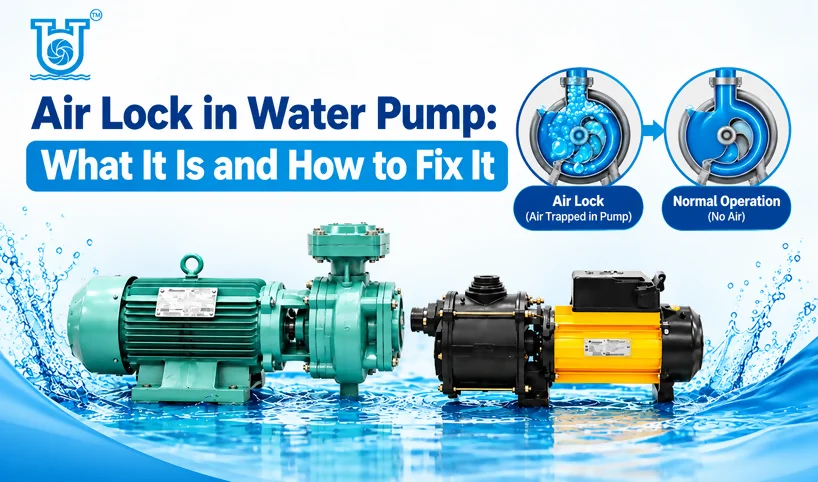
Your water pump is running, but little or no water is coming out. You may also notice irregular water flow, sputtering at the outlet, or unusual sounds from the pump.
One possible reason is trapped air. An air lock in a water pump can prevent water from moving properly through the pump or piping system. However, not every case of a water pump running but not pumping water is caused by an air lock. Loss of prime, a suction leak, low water level, a blocked pipe, or cavitation can produce similar symptoms.
Understanding the difference can help you find the actual problem and avoid unnecessary repairs.
What is an air lock in a water pump?
An air lock occurs when a pocket of air becomes trapped in a part of the pump or piping where it interferes with the normal movement of water.
This is particularly relevant to centrifugal and other surface pumping systems that depend on a water-filled suction path. A centrifugal pump is designed to move liquid. If enough air collects around the impeller or in the suction line, the pump may be unable to create the conditions needed to move water effectively.
Air can also become trapped at high points or poorly arranged sections of piping.
An air lock is closely related to priming problems, but the terms do not mean exactly the same thing.
Priming means filling the pump casing and, where required, the suction line with water before operation. Loss of prime means that this water has been lost or replaced by air. An air lock is a trapped pocket of air that prevents or restricts normal water movement.
What causes air lock in a water pump?
Air can enter or remain in a water pumping system for several reasons.
- Improper priming: Many surface centrifugal pumps need to be properly primed before starting. If the pump casing or suction line is not completely filled as required by the pump design, trapped air can prevent normal pumping.
- Air entering the suction line: A suction pipe should normally be airtight. A small leak at a fitting, joint, hose, seal, or connection can allow air to enter even when there is no obvious water leak.This can lead to irregular flow or cause the pump to lose its prime.
- Loose pipe connections: Loose threaded connections, damaged seals, cracked pipes, or poorly fitted components can introduce air into the suction side.
- Low water level: If the water level drops too close to or below the suction inlet, the pump may begin drawing air along with water. This can happen in wells, tanks, ponds, and other water sources.
- Faulty foot valve: A foot valve is a non-return valve fitted near the bottom of some suction pipes. It helps keep the suction pipe filled when the pump stops. If the valve leaks or does not close correctly, water can drain back into the source. Air then replaces the lost water, and the pump may need to be primed again.
- Poor suction pipe installation: High points, unnecessary bends, or incorrect pipe routing can create places where air collects. Suction piping should be installed according to the pump manufacturer’s requirements.
- Pump has been unused: Water may drain from some systems during a long period of inactivity, particularly if a valve or connection is leaking. The pump may then contain air when it is restarted.
Common signs of air lock in a water pump
The symptoms depend on the pump and installation, but common signs include:
- The pump motor runs but little or no water is delivered
- Water flow starts and stops or becomes inconsistent
- Air and water sputter from taps or outlets
- The pump repeatedly loses its prime
- Unusual gurgling or irregular sounds come from the pump or piping
- Water pressure is lower than normal
- The pump works after priming but develops the same problem again
These symptoms do not prove that there is an air lock. A blocked suction pipe, low water source, damaged impeller, suction leak, or other problem can produce similar results.
How to check if your water pump has an air lock
Before trying to remove trapped air, first check whether air lock is really the cause of the problem.
Start by observing how the pump behaves.
If the pump motor is running but water flow is weak, irregular, or completely stopped, check whether air is coming from the outlet. Sputtering water or bursts of air can indicate that air has entered the system.
For surface pumps that require priming, check whether the pump casing and suction line are still filled with water. If the pump has lost its prime, air may have entered through a leaking connection, faulty foot valve, or falling water level.
Also inspect the suction side for:
- Loose pipe connections
- Cracked or damaged suction pipes
- Leaking seals or fittings
- A blocked strainer or foot valve
- A water level that has fallen too low
- High points in the suction pipe where air may collect
If the pump starts working normally after proper priming but the same problem returns later, the issue is more likely to be a suction leak, faulty foot valve, or another problem that is allowing air back into the system.
Do not assume every case of a water pump running but not pumping water is caused by an air lock. A blocked suction line, low water level, damaged impeller, or cavitation can produce similar symptoms.
How to fix an air lock in a water pump
The correct method depends on the pump type and installation.
Important safety note: Switch off and isolate the electrical power before inspecting, opening, servicing, or working on a water pump. Do not open a pump or fitting while the system is pressurized. Follow the manufacturer’s operating and safety instructions for your specific pump.
For a typical surface pump that requires priming, the general process is:
Step 1: Switch off the pump
Disconnect or isolate its electrical supply before starting any inspection.
Step 2: Confirm there is enough water
Check that the water source has not fallen below the required operating level.
Step 3: Inspect the suction side
Check the suction pipe, joints, valves, fittings, and seals for obvious damage or loose connections.
Step 4: Prime the pump correctly
If the pump is designed for manual priming, open the appropriate priming point and fill the pump casing with clean water according to the manufacturer’s instructions.
Depending on the installation, the suction line may also need to remain filled.
Step 5: Allow trapped air to escape
Use the pump’s designated priming or venting arrangement if provided. Do not loosen random fittings on a pressurized system simply to release air.
Step 6: Close the priming or vent point
Once the pump has been correctly filled and air removed, securely replace the plug or cap.
Step 7: Restore power and test
Start the pump according to its operating instructions and check whether a steady water flow returns.
If the pump loses prime again, stop troubleshooting it as a one-time air lock. Look for an underlying suction leak, defective foot valve, low water level, blocked inlet, or installation problem.
What about self-priming pumps?
A self-priming pump is designed to handle air in its suction line better than a conventional non-self-priming centrifugal pump after the pump has been initially prepared according to its design.
However, “self-priming” does not mean the pump can operate indefinitely without water. The pump still needs to be installed, commissioned, and operated according to the manufacturer’s instructions.
How to prevent air locks in water pumps
A few installation and maintenance practices can reduce the chance of recurring air problems:
- Prime pumps correctly when their design requires it
- Keep suction pipe connections airtight
- Replace damaged seals, fittings, and hoses
- Inspect foot valves and strainers regularly
- Keep the suction inlet sufficiently below the water surface
- Avoid unnecessary high points in suction piping where air can collect
- Use the correct suction pipe size for the pump and installation
- Check the water level during periods of heavy use or low water availability
- Follow the manufacturer’s installation requirements
- Investigate repeated loss of prime instead of simply repriming the pump each time
Correct pump selection is also important. A pump should be chosen according to the water source, suction conditions, required flow, total head, and application.
Air lock vs other common water pump problems
Several pump problems can look similar at first. This comparison can help narrow down the cause.
| Problem | Common Signs | Possible Cause | What to Check |
|---|---|---|---|
| Air lock | Pump runs with little or no flow, irregular water delivery | Trapped air in pump or piping | Priming, pipe layout, trapped-air points |
| Loss of prime | Pump stops drawing water after previously working | Water drained from pump or suction line | Prime level, foot valve, suction leaks |
| Suction leak | Irregular flow, repeated loss of prime, air in water | Loose joint, cracked pipe, damaged seal | Suction fittings, pipe, seals and connections |
| Blocked suction line | Low or no flow | Debris, sediment, blocked strainer or foot valve | Suction pipe, strainer and foot valve |
| Low water level | Flow drops during operation or pump begins drawing air | Water source has fallen below safe intake level | Tank, well or source water level |
| Cavitation | Rattling or crackling noise, vibration, reduced performance | Pressure at pump inlet is too low for operating conditions | Suction conditions, restrictions, pipe sizing and pump selection |
Cavitation deserves particular attention because it is often confused with air entering a pump.
Cavitation occurs when local pressure inside the pump becomes low enough for the liquid to form vapor bubbles. Those bubbles then collapse as they move into a higher-pressure area. It is therefore different from ordinary air leaking into the suction line.
Persistent cavitation can damage pump components and should not be ignored.
Can submersible pumps get air locked?
This question requires a distinction between different pump installations.
A typical borewell submersible pump operates while submerged in water. Its pump stages and motor are located down in the water source, so it does not depend on a long suction pipe above the water level in the same way that a conventional surface centrifugal pump does.
For this reason, the usual surface-pump problem of manually priming a suction line does not apply in the same way to a properly submerged borewell pump.
However, air or gas can still cause pumping problems in certain submerged installations. For example, a falling water level may expose the pump inlet or allow air to be drawn into the pump. Air may also become trapped in parts of the discharge system depending on its layout.
If a submersible pump is running but not delivering water, do not automatically assume that it needs priming. Possible causes include:
- Water level falling below the pump inlet
- Blocked pump inlet
- Damaged or worn pump components
- Discharge pipe problems
- Check valve problems
- Electrical or motor problems
- Incorrect installation
Open well submersible pumps also differ from conventional surface suction pumps. For example, Unnati’s horizontal open well pumps operate underwater and do not require a suction pipe.
Identifying the pump type is therefore one of the first steps in accurate troubleshooting.
When should you call a pump technician?
Basic checks can solve simple priming or trapped-air problems, but some situations require professional inspection.
Contact a qualified pump technician if:
- The pump repeatedly loses prime
- You cannot locate a suction leak
- The pump makes persistent rattling, grinding, or unusual mechanical noises
- The motor overheats or repeatedly trips its protection
- Electrical components need inspection
- The pump has to be removed from a borewell
- Water delivery remains poor after checking the water level and piping
- You suspect internal pump damage
- Cavitation continues during operation
Repeatedly restarting a pump without identifying why it is not delivering water can turn a minor system problem into a more serious repair.
Choosing the right water pump for reliable water flow
Preventing pumping problems starts with choosing a pump suited to the water source and installation.
A surface centrifugal pump, self-priming pump, open well pump, and borewell submersible pump handle water in different ways. The right choice depends on factors such as the source depth, required flow, pumping head, suction conditions, installation environment, and intended application.
Unnati Pumps offers pumping solutions for water supply, agriculture, irrigation, construction, industrial applications, and municipal water supply. Its range includes surface centrifugal pumps, self-priming mini monoblock pumps, open well monoblock pumps, and borewell submersible pumps.
When comparing pumps, focus on the requirements of the complete water system rather than choosing only by motor power. Correct pump selection, pipe sizing, installation, and water availability all contribute to reliable water flow.
Frequently asked questions
1. What causes an air lock in a water pump?
An air lock can occur when air becomes trapped in the pump or piping and interferes with water movement. Poor priming, suction leaks, low water levels, leaking foot valves, and incorrect pipe layouts are common reasons air can enter or remain in a pumping system.
2. How do I remove air from a water pump?
For a surface pump that requires priming, switch off and isolate the electrical power first. Check the water source and suction line, then prime and vent the pump according to the manufacturer’s instructions. The exact method depends on the pump design.
3. Can an air lock damage a water pump?
An air lock itself may stop or reduce water delivery, but the greater risk can come from continuing to operate a pump without adequate water when the pump is not designed for dry running. Stop the pump and investigate the cause if normal flow does not return.
4. Why is my water pump running but not pumping water?
Possible causes include trapped air, loss of prime, a suction leak, low water level, a blocked suction pipe or strainer, faulty valves, incorrect pump installation, or damaged pump components. The correct diagnosis depends on the pump type and water system.
5. How can I tell if my pump has lost its prime?
A surface pump that requires priming may run without delivering water when its casing or suction line is no longer adequately filled. If repriming temporarily restores normal operation but the problem returns, check for suction leaks, a faulty foot valve, or falling water level.
6. Can a submersible water pump get an air lock?
A fully submerged borewell pump does not normally have the same suction-line priming problem as a surface pump. However, air or gas can affect some submerged systems, particularly if the water level drops near the pump inlet or air becomes trapped in the discharge system.
7. How can I prevent air from entering my water pump?
Keep suction connections airtight, maintain the correct water level, inspect foot valves and seals, use proper pipe routing, and prime the pump according to its design. If the pump repeatedly draws air or loses prime, find and repair the underlying cause rather than repeatedly restarting it.