

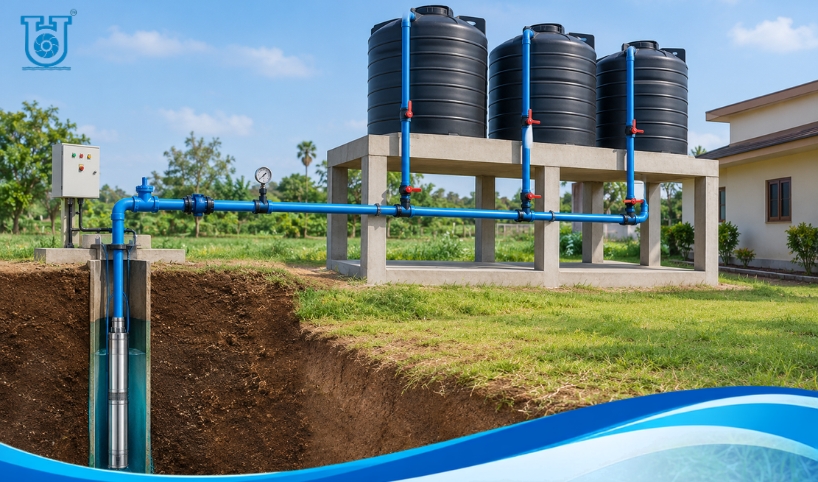
A borewell pump is commonly used to supply water to homes, farms, commercial buildings, and industrial facilities. In many places, water is needed at more than one location. For example, a house may have two overhead tanks, a farm may have separate storage tanks for irrigation, or a building may need water on different floors.
This raises an important question: Can one borewell pump supply water to multiple tanks?
The answer is yes. One borewell pump can supply water to two or more tanks if the system is properly designed. However, the pump must have enough capacity to deliver water to all the required tanks. Factors such as pump pressure, water flow, pipe size, tank height, and distance between tanks play an important role.
In this guide, we explain how a single borewell pump can supply multiple tanks, what equipment is required, and how to maintain a reliable water supply.
How Does One Borewell Pump Supply Water to Multiple Tanks?
A borewell pump draws groundwater from a borewell and pushes it through a delivery pipe. To supply multiple tanks, the main delivery pipe is connected to separate pipelines that lead to each tank.
For example, if you have three water tanks, the main pipeline can be divided into three branches. Each branch carries water to a different tank.
A typical system includes:
- Borewell pump: Draws water from the borewell and delivers it to the tanks.
- Main delivery pipe: Carries water from the pump to the distribution point.
- Branch pipelines: Direct water to individual storage tanks.
- Control valves: Regulate or stop water flow to specific tanks.
- Float valves or level sensors: Help prevent tanks from overflowing.
- Electrical control panel: Controls pump operation and provides suitable protection.
The pump can fill the tanks simultaneously or one at a time, depending on the system design and available pump capacity.
Can a Single Borewell Pump Fill Multiple Tanks at the Same Time?
Yes, a single borewell pump can fill multiple tanks simultaneously. However, the pump must deliver enough water at the pressure required by the distribution system.
For example, suppose a pump delivers 6,000 litres of water per hour at the required operating head. If three tanks receive equal water flow, each tank could receive approximately 2,000 litres per hour.
In practice, the water may not be distributed equally. Tanks located closer to the pump or at a lower height may receive more water because they have less resistance to flow.
To improve water distribution, the system may require properly sized pipelines, balancing valves, or automatic controls.
It is also important to understand that a pump’s rated maximum flow is not necessarily the flow it will deliver after accounting for tank height, pipe friction, and other system losses.
What Factors Should You Consider Before Connecting Multiple Tanks?
Before connecting multiple tanks to one borewell pump, consider the following factors.
1. Pump Capacity
Pump capacity is one of the most important factors. The pump must provide enough water to meet the combined requirements of the tanks.
For example, if you have two tanks with capacities of 2,000 litres and 3,000 litres, the total storage capacity is 5,000 litres.
If you want to fill both tanks within two hours, the system needs an average flow of approximately 2,500 litres per hour.
However, the actual pump selection must also consider the required head, pipe losses, borewell yield, and operating conditions.
2. Height of the Water Tanks
The height of the tanks affects the pressure required from the pump.
A tank installed on a higher floor generally requires more pressure than one located near ground level.
If the tanks are installed at different heights, water may flow more easily into the lower tank. Proper valves and controls can help manage this difference.
3. Distance Between Tanks
The distance between the pump and each tank also affects water delivery.
Longer pipelines create additional friction losses, which can reduce the available flow.
For example, a tank located 20 metres from the distribution point may receive more water than a similar tank located 100 metres away, depending on the pipe sizes and elevation differences.
4. Pipeline Size
Using the correct pipe diameter is essential for maintaining water flow.
Pipes that are too narrow can create excessive friction losses, especially when multiple tanks are filled at the same time.
A qualified pump technician can calculate the appropriate pipe diameter based on the required flow, pipeline length, and pressure.
5. Borewell Water Availability
The borewell must provide enough water to support the planned pumping operation.
Even if the pump has sufficient capacity, a borewell with a low water yield may not support continuous pumping.
Running a pump when insufficient water is available can cause overheating or damage, depending on the pump design and protection system.
Is It Better to Fill Multiple Tanks Together or Separately?
Both methods are possible, but the best option depends on your requirements.
| Filling method | Advantages | Limitations |
| Simultaneous filling | Supplies multiple tanks together and may reduce the number of operating cycles | Requires sufficient pump flow and proper distribution |
| Sequential filling | Makes it easier to control which tank receives water | Takes longer to fill all tanks and may require additional controls |
For residential buildings with two or three tanks, simultaneous filling may be convenient if the pump has adequate capacity.
For agricultural or industrial applications where tanks are located at different distances or elevations, sequential filling may offer better control.
The correct method should be selected based on the actual pump performance and water demand.
How to Connect One Borewell Pump to Multiple Water Tanks
Connecting multiple tanks requires careful planning to maintain consistent water flow and protect the pump.
Step 1: Calculate the total water requirement
Identify the capacity of each tank and how quickly you want to fill them. This helps determine the required flow rate.
Step 2: Check the pump performance
Review the pump’s performance curve to confirm that it can deliver the required flow at the calculated total dynamic head. This includes the pumping water level, tank elevation, friction losses, and other system losses.
Step 3: Install the distribution pipelines
Connect the main delivery pipe to separate branch pipelines. Use appropriate pipe fittings and ensure the connections are secure.
Step 4: Install control valves
Provide suitable valves for each branch so water flow can be regulated or isolated when necessary. Include check valves where required to prevent unwanted reverse flow.
Step 5: Add automatic tank controls
Install compatible water level sensors or automatic control valves to stop water delivery when individual tanks become full. The control system must also stop or safely regulate the pump when there is no demand.
Step 6: Test the complete system
Run the pump and check water flow, operating pressure, tank filling times, and electrical performance. Confirm that the pump remains within its recommended operating range.
Common Problems When Supplying Water to Multiple Tanks
Although one borewell pump can serve multiple tanks, an incorrectly designed system may experience several problems.
Uneven Water Distribution
One tank may fill faster than another because of differences in elevation, pipeline length, or pipe resistance.
Properly sized pipes and balancing valves can help improve water distribution.
Low Water Pressure
If the pump cannot maintain sufficient head at the combined flow rate, water may reach distant or elevated tanks slowly.
In this situation, the pump performance and complete pipeline arrangement should be reviewed.
Tank Overflow
Without suitable level controls, water may continue entering a tank after it becomes full.
Automatic tank level controls can help prevent overflow and unnecessary water wastage.
Frequent Pump Starting and Stopping
If individual tanks frequently request small amounts of water, the pump may start and stop too often.
Excessive cycling can affect motor life and electrical components. A properly designed control system can help reduce unnecessary starts.
Pump Running Without Water
If the borewell water level drops below the required operating level, the pump may experience insufficient water flow.
Suitable dry running protection and water level monitoring can help protect the pumping system.
When Should You Consider a Separate Pump?
Using one pump is often practical, but it may not be the best solution for every installation.
A separate pump or a central storage and distribution arrangement may be more suitable when tanks are located at very different heights, water demand is high, or individual locations require independent operation.
For example, a large commercial building may benefit from pumping borewell water into a central storage tank and using a separate distribution pump to supply different floors.
This arrangement can provide greater control over water pressure and tank filling.
However, additional equipment also increases installation and maintenance requirements. The most suitable option depends on the site conditions and water demand.
Choosing the Right Borewell Pump for Multiple Tanks
When selecting a borewell pump for multiple tanks, focus on the required flow rate and total dynamic head rather than choosing a pump based only on horsepower.
A suitable pump should provide the required water flow while operating efficiently within its recommended performance range.
Unnati Pumps offers a range of submersible pumps for domestic, agricultural, and industrial water supply applications. Different pump models are available to suit various borewell depths, discharge requirements, and operating conditions.
For an installation involving several tanks, share the borewell depth, pumping water level, tank elevations, pipeline lengths, and water requirements with a qualified pump supplier or installer before selecting a model.
Conclusion
One borewell pump can supply water to multiple tanks, making it a practical solution for homes, farms, commercial buildings, and industrial facilities.
However, successful operation depends on proper pump selection, pipeline design, tank height, water demand, and automatic controls. A correctly designed system can provide dependable water distribution while reducing unnecessary pump operation and maintenance problems.
If you are planning a water supply system for multiple tanks, explore the range of borewell submersible pumps available from Unnati Pumps. Our team can help you identify suitable pumping options based on your application and technical requirements.
Frequently Asked Questions
1. Can a 1 HP borewell pump fill two water tanks?
A 1 HP borewell pump may be able to fill two tanks, depending on the pumping water level, tank height, pipeline length, and required flow rate. Horsepower alone cannot confirm whether the pump is suitable. Always check its performance curve.
2. Can one borewell pump supply water to three or four tanks?
Yes. One borewell pump can supply three or four tanks if it has sufficient flow and head capacity. Proper branch pipelines, control valves, and tank level controls are also important.
3. Will connecting multiple tanks reduce water pressure?
Connecting multiple tanks can reduce the available flow or pressure at individual outlets if the system is not designed for the combined demand. Correct pump selection and pipe sizing help maintain suitable water delivery.
4. Do I need separate float valves for each water tank?
Each tank should have suitable individual level control to prevent overflow. Depending on the system, this may involve mechanical float valves, electrical level sensors, or automatic valves connected to a central controller.
5. Can a borewell pump automatically fill multiple tanks?
Yes. An automatic control system can monitor the water level in each tank and operate valves and the pump as required. The system should also include suitable protection against dry running, excessive pressure, and operation outside the pump’s recommended range.