

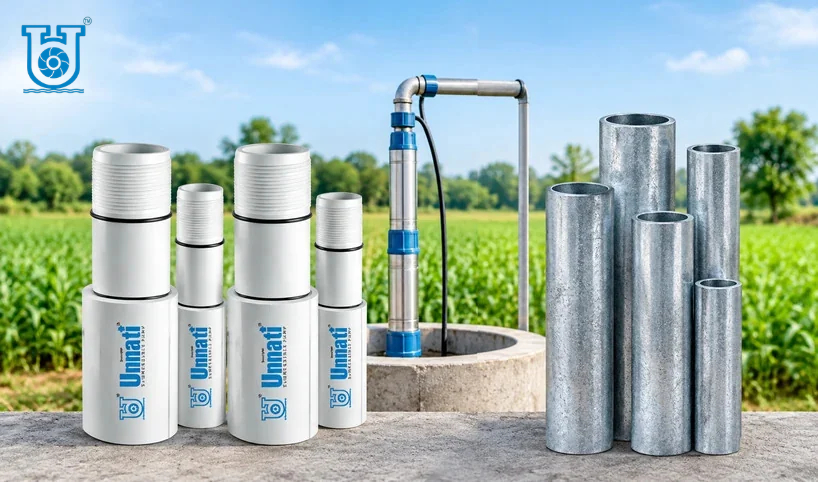
The column pipe is the line that hangs your submersible pump in the borewell and carries water up to the surface. It does two jobs at once: it holds the full weight of the pump, the motor, the pipe itself and the water inside it, and it carries the pressure the pump builds. If it fails, the pump can end up at the bottom of the well.
For years, galvanised iron (GI) pipe was the default choice. Today, many installers and farmers use uPVC column pipe instead. So which is better? The honest answer is that uPVC column pipe vs GI pipe is not a contest with one winner for every well. It depends on depth, pump size, water quality and how the installation will be handled.
The Quick Verdict
For most agricultural, domestic and light commercial borewells, a correctly rated uPVC column pipe is the more practical choice, mainly because it does not corrode and is far easier to handle. GI pipe still has a place where loads exceed what the available uPVC grades are rated for, where pipe size or duty falls outside the uPVC range, or where a project specification calls for steel.
The rest of this article explains why.
Side-by-Side Comparison
| Factor | uPVC column pipe | GI pipe |
| Corrosion | Does not rust; inert to most groundwater chemistry | Zinc coating wears away, then the steel rusts, fastest at threads |
| Scale build-up | Smooth bore resists scaling | Rough, rusting bore collects scale over time |
| Weight | Light; easier to lift and transport | Heavy; usually needs a tripod and chain pulley |
| Joints | Square threads with rubber seals in many designs | Tapered threads with sockets, sealed with tape or compound |
| Strength | Rated by load class; must match depth and pump weight | High tensile strength; less sensitive to load class |
| Heat and sunlight | Softens with heat; needs shaded storage | Not affected |
| Earthing | Non-conductive; earth the motor through the cable | Conductive, but should not be relied on as the earth path |
| Maintenance | Low; threads can be reused if handled well | Threads and pipe may need replacing after corrosion |
| Cost | Depends on class, size and brand | Depends on steel price and wall class |
How They Differ in Practice
Corrosion and water quality
This is the biggest difference. GI pipe relies on a zinc coating to protect the steel. Once that coating is worn, scratched or cut away at the threads, the steel underneath starts to rust. In acidic, salty or mineral-rich water, this can happen quickly. Threads are the weak spot because the wall is thinnest there and the coating is removed during threading.
Rust also causes a second problem: pieces of scale break off and can wear the pump or block the strainer. And when a GI pipe is connected directly to a stainless steel pump in salty water, the two metals can set up galvanic corrosion, with the GI side losing out.
uPVC does not rust or react with most groundwater, which is why it is widely used in saline and hard-water areas. If your water is aggressive, this alone often settles the choice. For more on how salt water affects every part of the installation, see our guide to choosing pump materials for saline groundwater.
Weight and installation
A string of GI pipe for a deep borewell is heavy. Lowering and pulling it usually needs a tripod, chain pulley block and a full crew. uPVC column pipe weighs much less, so moderate-depth installations can often be handled with less equipment, and transport costs drop.
That lighter weight does not mean less care. uPVC joints must be tightened correctly, without grease on the threads unless the maker allows it, and without over-tightening. Our step-by-step guide on how to install a submersible pump covers the wider installation process.
Strength and load ratings
GI pipe is strong in tension, so it tolerates heavy loads well. uPVC column pipes are made in different load classes (names such as medium, standard, heavy and super heavy vary between manufacturers). Each class is rated for a maximum combined load of pump, motor, pipe and water at a given depth.
Choosing a class that is too light is the most common cause of uPVC column failure. Always compare:
- Total setting depth of the pump
- Weight of the pump and motor
- Pipe size and the weight of the water column
- Maximum pump pressure (shut-off head)
- Starting torque, especially for larger three-phase motors
Ask the pipe manufacturer for the rated load and depth for each class and pipe size, and stay within it. Many installers also tie a stainless steel or nylon safety rope to the pump as a backup, and some manufacturers recommend this.
Friction and pump efficiency
A new GI pipe and a new uPVC pipe of the same bore have broadly similar friction. The difference grows with time. As GI rusts and scales inside, the bore gets rougher and narrower, so friction loss rises and the pump delivers less water for the same energy. uPVC keeps its smooth bore far longer. For deep wells where every metre of head counts, this matters. Our article on how borewell depth affects pump selection explains why friction losses become more important as wells get deeper.
Heat, sunlight and storage
uPVC loses strength as temperature rises and can be damaged by long exposure to sunlight. Store pipes in shade, keep threads capped and clean, and check the maker’s temperature limits if your groundwater is warm. GI has no such limits.
Electrical safety
With GI pipe, some installers assume the metal pipe acts as an earth path. It should not be relied on for that. With uPVC, the pipe is non-conductive, so the motor must be earthed through the earth conductor in the drop cable and the control panel. Use a properly rated submersible pump cable with an earth core and follow local wiring rules.
When GI Pipe Still Makes Sense
- Installations where the load exceeds the rating of the heaviest uPVC class available
- Pipe sizes or duties outside the uPVC range the supplier offers
- Projects where the tender or engineer specifically calls for steel column
- Very hot groundwater beyond the uPVC maker’s temperature limits
When uPVC Is the Better Pick
- Salty, acidic, iron-rich or hard water
- Domestic and agricultural borewells within the pipe’s rated depth and load
- Sites where installation equipment and crew size are limited
- Users who want to reduce scaling and pull the pump less often
Questions to Ask Before You Buy
- What is the rated load and maximum depth for this pipe class and size?
- What joint design is used, and are seals included?
- What is the recommended tightening method and tool?
- Is a safety rope recommended, and how should it be attached?
- What are the storage and temperature limits?
Unnati Pumps manufactures uPVC column pipes with square-threaded joints and rubber sealing, including heavy-duty series with extra-long couplers for higher loads. Share your setting depth and pump details with our team, and we’ll recommend a pipe class rated for your setup. Contact Unnati Pumps for expert guidance and a quote.
Frequently Asked Questions
Can I replace existing GI pipe with uPVC column pipe?
Yes, in many cases. You will need the correct adapters at the pump and the wellhead, and a uPVC class rated for your depth and pump weight. This is a good moment to inspect the pump and cable as well.
How long does uPVC column pipe last compared with GI?
In corrosive water, uPVC usually outlasts GI because it does not rust. In both cases, service life depends heavily on correct load rating, careful handling and proper tightening.
Is uPVC column pipe strong enough for a deep borewell?
It can be, as long as you choose the right load class. Each class is rated for a maximum combined load of pump, motor, pipe and water at a given depth. Check the rated load and depth for your pipe size with the manufacturer, and stay within it. For deeper wells or heavier pumps, heavy-duty series are designed for higher loads.
Does uPVC column pipe corrode in salty or hard water?
No. uPVC does not rust or react with most groundwater, which is why it is widely used in saline and hard-water areas. It also keeps a smooth bore, so scale build-up is much lower than in GI pipe.
Does uPVC column pipe need separate earthing?
Yes. uPVC is non-conductive, so the motor must be earthed through the earth conductor in the drop cable and the control panel. Use a properly rated submersible pump cable with an earth core and follow local wiring rules.