

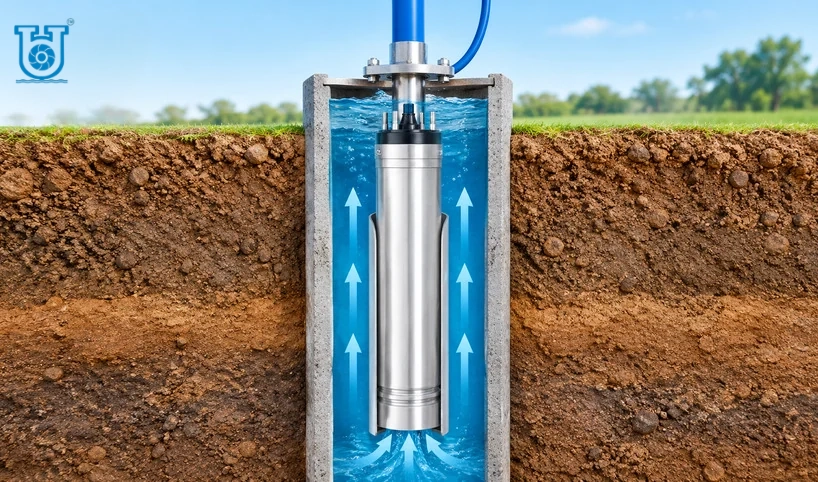
A farmer replaces a burnt 6 inch submersible motor. Six months later, the new one fails the same way. The pump was the right size for the head and flow. The voltage was steady. The real cause sat in plain sight: a 6 inch motor hanging in a 10 inch borewell, with very little water moving past it.
This is the problem a submersible motor cooling sleeve solves. If water is not flowing fast enough along the outside of the motor, the motor cannot shed its heat, and its life gets shorter with every hour it runs.
Short answer: A cooling sleeve (also called a flow inducer sleeve or shroud) is needed whenever the water moving past the motor is slower than the minimum velocity set by the motor manufacturer. This usually happens in wide borewells, open tanks and sumps, wells where water enters above the pump, and pumps set below the well screen. The exact requirement always depends on the motor’s datasheet, so check it before you install.
How a Submersible Motor Keeps Itself Cool
A submersible motor has no fan. It is a sealed unit filled with water or oil, and all the heat from its windings has to pass through the motor shell into the surrounding water.
That only works if the water around the shell keeps moving. In a normal borewell, the motor sits below the pump intake, so the water the pump draws flows upward along the motor on its way in. This steady stream carries heat away.
If the water near the motor is still, it warms up and the motor runs hotter than its design temperature. Winding insulation ages faster when hot, which is why poor cooling often ends in a burnt winding rather than a mechanical fault.
The Figure That Matters: Water Velocity Past the Motor
Motor makers do not specify cooling as “enough water”. They give a minimum flow velocity along the motor, measured in metres per second.
As one widely used example, Franklin Electric’s installation manual calls for at least 0.08 m/s (0.25 ft/s) past 4 inch motors rated 3 HP and above, and 0.15 m/s (0.5 ft/s) past 6 inch and 8 inch motors, in water up to 30°C. Unnati Pumps lists the same 0.15 m/s minimum cooling flow along the motor on its 6 inch cast iron submersible pump page. Other brands and models may set different figures, and some small 4 inch motors are rated to run without a sleeve at all. Your motor’s own datasheet is the only figure that counts.
How to check your own installation
Velocity depends on pump flow and the gap between motor and casing.
- Work out the gap area (the ring of open space around the motor): Area = 0.785 × (casing inner diameter² − motor outer diameter²), with both diameters in metres.
- Convert the pump flow to cubic metres per second (m³/h ÷ 3600).
- Divide flow by area. The result is the velocity in m/s.
A worked example
Take a 6 inch motor with a 142 mm outer diameter (the maximum outer diameter listed for Unnati’s 6 inch water lubricated stainless steel motor) running a pump that delivers 12 m³/h.
| Installation | Gap area | Velocity past motor | Against a 0.15 m/s minimum |
|---|---|---|---|
| 6 inch motor in a 254 mm (10 inch) casing | about 0.0348 m² | about 0.10 m/s | Too slow |
| Same motor inside a 180 mm inner diameter sleeve | about 0.0096 m² | about 0.35 m/s | Adequate |
Without a sleeve, this pump would need roughly 19 m³/h to cool the motor properly. The sleeve narrows the gap, so the same 12 m³/h moves much faster.
Situations Where a Sleeve Is Usually Needed
- Wide borewells or casings. A small motor in a big hole is the most common case, as in the example above.
- Open water, tanks and sumps. With no casing at all, water reaches the intake from every side and barely touches the motor. Most manufacturers treat a sleeve as essential here.
- Top-feeding or cascading wells. If water enters the well above the pump, it flows down to the intake and never passes the motor.
- Pump set in or below the screen. Water enters through the slots near the intake rather than flowing up from below the motor.
- Horizontal installations in tanks or reservoirs.
- Warm groundwater. Hotter water carries away less heat, so many manufacturers ask for higher flow or a derated motor above their rated water temperature.
- Variable speed drives and solar pumps. At reduced speed, the pump delivers less water, so the minimum velocity must still be met at the lowest flow the system will run. Solar pumps face this every morning and evening, one reason solar pumps overheat.
What Happens When Cooling Falls Short
Poor cooling rarely causes an instant breakdown. It causes slow damage:
- The overload trips after long running periods
- Insulation resistance readings drop from one service to the next
- Mineral scale builds up on the hot motor shell, insulating it further
- The winding finally burns out, often blamed on voltage when the real cause was heat
If a motor failed early, check cooling flow along with voltage. Our article on common causes of submersible pump failures covers the other possibilities.
How to Fit a Cooling Sleeve
A sleeve is simply a tube that fits around the motor and pump intake. It is closed at the top, above the intake, and open at the bottom, below the motor. Water has only one route to the pump: in at the bottom, up along the motor, and into the intake.
General installation steps
- Choose the sleeve diameter. It must be large enough to slide over the motor and pump with clearance for the cable, but small enough to give the required velocity. Run the calculation above with the sleeve’s inner diameter.
- Choose the material. PVC pipe is common for clean water. Stainless steel is used where strength or corrosion resistance matters.
- Seal the top. Clamp the top of the sleeve to the pump body above the intake screen, using a plate or collar. Any gap here lets water bypass the motor.
- Make room for the cable. Cut a slot or fit a cable guide at the top seal so the drop cable is not pinched or cut.
- Centre the motor. Use centring bolts or spacers so the motor does not touch the sleeve wall. Many manufacturers say these should bear on the motor casting, not on the thin stator shell.
- Extend below the motor. The open end should sit below the bottom of the motor so water enters cleanly.
Mistakes That Undo the Benefit
- Leaving the top unsealed, so water goes straight to the intake
- Making the sleeve so tight that it rubs the motor or adds friction
- Clamping onto the stator shell and denting it
- Pinching the drop cable at the top seal
- Expecting a sleeve to fix a motor that is undersized for the duty
When a Sleeve Is Not the Best Answer
Sometimes the better fix is a different pump. On a new borewell, matching motor size to the casing can remove the need for a sleeve. Our guide to how borewell depth affects pump selection explains how bore size and depth shape that choice. For a shallow open well or sump, a surface-mounted or open well monoblock pump may suit the job better than a submersible unit.
Get the Numbers Before You Lower the Pump
A cooling sleeve costs very little compared with a rewind, but it only helps when it is sized for your flow and casing. Note your casing diameter, motor diameter and expected flow, then compare the velocity with the motor datasheet. If you need help matching a motor to your borewell, Request a quote from Unnati Pumps team can share specifications for our submersible motors and suggest a suitable setup.
Frequently Asked Questions
How do I know if my submersible motor is overheating from poor cooling?
Poor cooling usually shows up gradually. Common signs are the overload tripping after long running periods, insulation resistance readings dropping from one service to the next, and mineral scale building up on the motor shell. If a motor has burnt out early, check the water velocity past the motor against the datasheet as well as the supply voltage.
Do solar pumps and VFD-driven pumps need a cooling sleeve?
Often, yes. At reduced speed the pump delivers less water, so the flow past the motor drops too. The minimum velocity must be met at the lowest flow the system will run, not just at full speed. Solar pumps hit this every morning and evening, so size the sleeve for the lowest operating flow.
Should I use a PVC or stainless steel cooling sleeve?
PVC pipe is the common choice for clean water because it is affordable and easy to cut on site. Stainless steel suits installations where strength or corrosion resistance matters, such as aggressive water or heavy handling. Whichever you choose, the inner diameter decides the water velocity, so calculate it before you buy or cut the pipe.
Can I make a cooling sleeve myself?
Many installers make sleeves from PVC pipe on site. What matters is the correct inner diameter, a tight top seal, a safe cable path and proper centring. If in doubt, ask the motor supplier for their recommended sleeve dimensions.
Does a cooling sleeve reduce pump output?
A correctly sized sleeve adds only a small friction loss. A sleeve that is too tight can affect performance, which is why sizing should be calculated rather than guessed.