

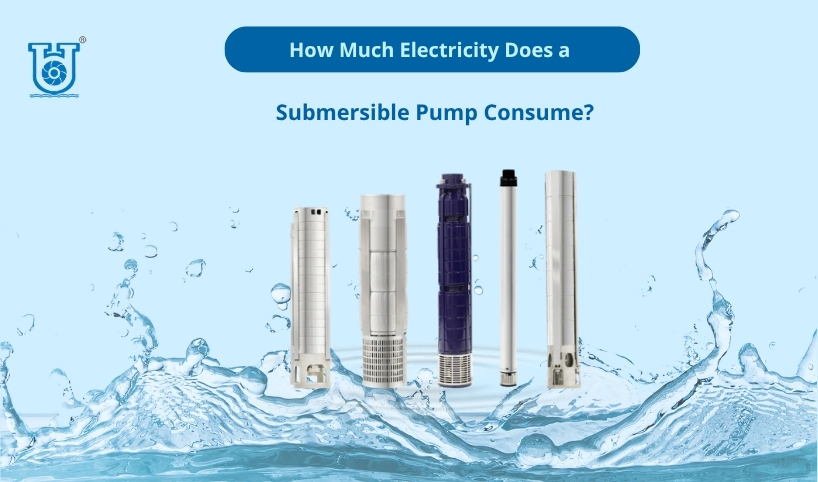
Running a submersible pump is a long-term commitment. The purchase price is a one-time cost, but electricity bills follow you every single month. Whether you are managing a borewell for irrigation in Egypt, handling a water supply project in Mexico, or running an industrial installation in Algeria, the power consumption of your pump directly shapes your operating budget.
This post covers how to calculate submersible pump electricity consumption, what factors actually change the numbers, and what real monthly costs look like across different pump sizes and markets.
What Affects How Much Electricity a Submersible Pump Uses?
Two pumps with the same HP rating can consume noticeably different amounts of electricity. The HP is just a starting point. What actually determines your monthly unit count is a combination of several things:
Motor horsepower (HP)
Larger pumps draw more power. A 10 HP motor will always consume more electricity than a 1 HP motor running the same number of hours. But within the same HP category, there is still meaningful variation based on the factors below.
Motor efficiency
This is the most important and most overlooked variable. A pump does not pull exactly 0.746 kW per HP from the grid. The motor converts electrical energy into mechanical energy, and no motor does that at 100%. A standard motor running at 75% efficiency will use more electricity for the same output compared to a BEE 5-star rated motor running at 85%+ efficiency. That gap adds up fast over months of continuous use.
Total head (depth and lift)
The deeper the water source or the higher it needs to be lifted, the harder the motor works. A pump pushing water from 80 meters down consumes noticeably more electricity than the same pump working at 20 meters.
Hours of operation per day
Everything multiplies here. A pump running 8 hours daily costs four times as much to operate as one running 2 hours, for the exact same period.
Voltage stability
In areas where grid voltage fluctuates, motors draw higher current to compensate. This increases electricity consumption and accelerates wear. Regions like Yemen and parts of rural Algeria can see significant voltage inconsistencies that affect both power use and pump lifespan.
How to Calculate Submersible Pump Power Consumption
The formula is simple:
Power consumed (kW) = (HP x 0.746) / Motor Efficiency
For daily or monthly figures:
Units consumed (kWh) = Power in kW x Hours of operation
Worked example: A 2 HP submersible pump with 78% motor efficiency, running 6 hours a day:
- Power = (2 x 0.746) / 0.78 = 1.91 kW
- Daily units = 1.91 x 6 = 11.47 kWh
- Monthly units = 11.47 x 30 = 344 kWh
For a single pump on a small farm, that is manageable. For a facility running five or ten pumps simultaneously, those numbers scale quickly.
Electricity Consumption by Pump Size: A Practical Reference
The table below uses an average motor efficiency of 78-80%, which is typical for standard-grade submersible motors. BEE 5-star or high-efficiency motors will consume 8 to 12% less for the same output.
| Pump Size | Power Draw | Units per Hour | Units per Day (8 hrs) |
|---|---|---|---|
| 0.5 HP | 0.48 kW | 0.48 units | 3.8 units |
| 1 HP | 0.96 kW | 0.96 units | 7.7 units |
| 2 HP | 1.91 kW | 1.91 units | 15.3 units |
| 5 HP | 4.78 kW | 4.78 units | 38.2 units |
| 10 HP | 9.56 kW | 9.56 units | 76.5 units |
| 15 HP | 14.33 kW | 14.33 units | 114.6 units |
| 20 HP | 19.1 kW | 19.1 units | 152.8 units |
| 50 HP | 47.9 kW | 47.9 units | 383 units |
What Do These Numbers Mean for Running Costs?
Electricity tariffs vary considerably across markets. Here is what a 1 HP submersible pump running 6 hours a day would cost per month in the key markets where pumps are most actively deployed:
Egypt
Commercial and agricultural electricity rates in Egypt generally fall between $0.03 and $0.06 per kWh depending on the consumption tier and zone. At a mid-range rate of $0.05/kWh, a 1 HP pump at 6 hours daily costs roughly $8.60 per month. A 5 HP irrigation pump under the same schedule would run around $43/month, and that figure climbs with larger units supplying multiple fields.
Mexico
Agricultural electricity in Mexico falls under dedicated tariff categories (Tarifa 9 and related schedules) that are partially subsidized for irrigation use. Effective rates typically range from $0.04 to $0.08 per kWh. A 5 HP pump running 6 hours daily would cost between $34 and $68 per month depending on region. The variance is significant enough that motor efficiency becomes a real financial decision for large irrigation setups.
Algeria
Algeria’s agricultural electricity rates are among the lowest in the region due to state subsidies, often below $0.04/kWh. Running costs per pump are relatively low, but for large-scale operations managing dozens or hundreds of pump installations, the difference between a standard motor and an energy-efficient one still compounds into a meaningful annual saving.
Morocco
Morocco has a more market-linked tariff structure. Commercial and agricultural users typically pay between $0.09 and $0.13 per kWh. At those rates, a 10 HP pump running 8 hours a day would cost between $85 and $120 per month. Efficiency ratings become a primary factor when evaluating which pump to specify for a project.
Yemen
Grid power availability in Yemen varies significantly by location. Where grid supply is consistent, rates have increased. In areas relying on diesel generators as backup or primary power, the effective cost per kWh can exceed $0.20, which makes the choice of motor efficiency especially important. An energy-rated motor paying for itself in under two years is not unusual in generator-dependent setups.
Why Motor Efficiency Has a Bigger Impact Than Most Buyers Expect
The numbers become clearer when you compare two motors of the same HP over a full year.
A standard 10 HP motor at 78% efficiency draws approximately 9.56 kW per hour. A BEE 5-star motor of the same rating at 88% efficiency draws about 8.48 kW. That is roughly 1.08 kW saved per hour.
Over a year of 8-hour daily operation:
- Annual hours: 2,920
- Units saved: 1.08 x 2,920 = 3,154 kWh per year per pump
At $0.10/kWh, that is around $315 saved annually on a single pump. For a distributor supplying 50 or 100 units to a large agricultural scheme or municipal project, that saving becomes a significant part of the pitch to buyers.
BLDC (Brushless DC) and PMSM (Permanent Magnet Synchronous Motor) designs push efficiency further still, particularly in solar pump applications where the available input power is fixed and every watt of waste represents less water lifted.
Practical Ways to Reduce Submersible Pump Power Consumption
For those managing pump installations at any scale, a few consistent practices make a real difference in monthly electricity costs:
- Match pump size to the actual requirement: An oversized pump running at partial load wastes electricity. If the required flow rate and head can be handled by a 3 HP unit, running a 5 HP motor adds nothing except a higher bill. Getting the specification right at the start is cheaper than replacing equipment later.
- Install voltage protection in areas with unstable grids: This is particularly relevant for installations in Yemen, parts of Algeria, and rural areas of Egypt and Morocco. Voltage fluctuations cause motors to draw excess current, which raises both electricity consumption and the risk of motor damage.
- Schedule operation during off-peak hours where possible: In countries with time-of-use tariffs, shifting pump operation to off-peak periods, typically late night or early morning, reduces costs without any change to the equipment.
- Keep the pump in good working condition: Worn impellers, partially blocked strainers, and degraded winding insulation all increase power draw without improving output. A pump running outside its optimal condition can consume 15 to 20% more electricity than one operating at spec.
- Evaluate solar for high-irradiance agriculture markets: In Egypt, Morocco, and Mexico, where sunlight availability is high, solar submersible pumps can eliminate daytime grid electricity costs entirely. Payback periods have shortened considerably as panel costs have dropped, making solar a financially sound option for farms with consistent daytime water demand.
A Note for Bulk Buyers, Dealers, and OEM Partners
If you are procuring submersible pumps in volume, whether for regional distribution, government water supply tenders, or OEM manufacturing, electricity consumption data should be part of your evaluation alongside price and build quality.
End customers in Morocco, Mexico, and Egypt are increasingly asking about running costs before committing to a purchase, particularly for larger HP units used in irrigation and municipal supply. Having verified efficiency ratings and certifications from your supplier makes it easier to answer those questions with confidence and closes deals faster.
Partnering with a manufacturer that provides BEE-certified, internationally tested motors means your clients get accurate performance data, not estimates. That matters when project contracts specify energy efficiency thresholds, which is becoming more common in government and infrastructure tenders across the MENA region and Latin America.
Conclusion
Electricity consumption is not something to estimate loosely. For any buyer evaluating submersible pumps for agricultural, industrial, or municipal use, understanding actual power draw and what it means for monthly costs is as important as understanding flow rate and head pressure.
The HP rating gives you a starting point. Motor efficiency, total head, operating hours, and voltage conditions determine what you actually pay. Getting those variables right at the specification stage, and choosing equipment with verifiable efficiency ratings, is consistently cheaper than correcting a bad purchase after installation.
For bulk pricing, motor efficiency specifications, or OEM partnership enquiries, contact the Unnati Pumps team for detailed product data and export terms.