

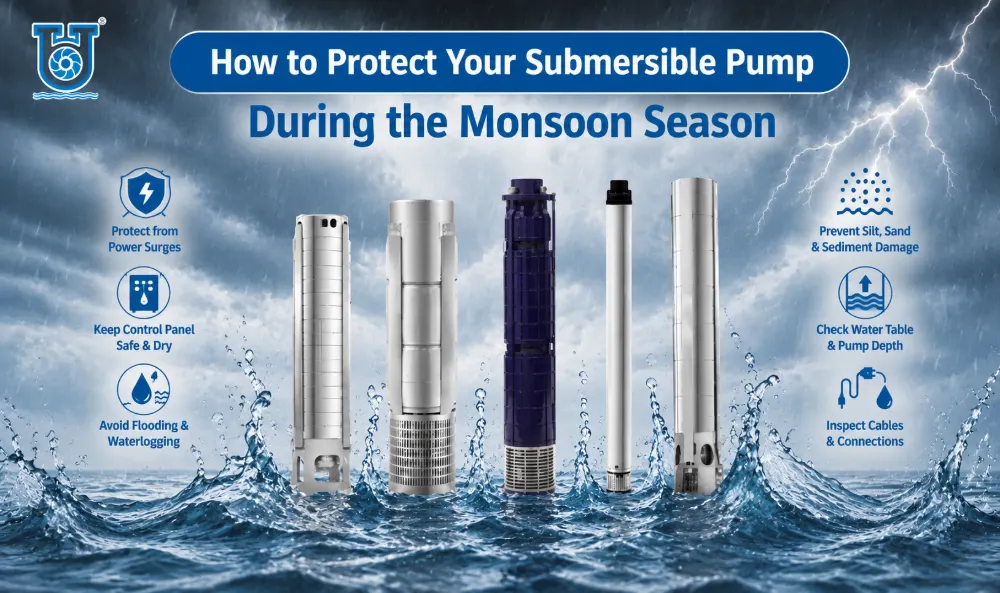
Picture this: the first heavy monsoon downpour has just hit, the fields finally have the water they’ve been waiting months for, and then the pump trips. Or worse, it goes quiet altogether. For a farmer relying on a borewell for irrigation, or a homeowner counting on a steady water supply during the rainy months, this is one of the most frustrating moments of the year. It usually isn’t bad luck. It’s almost always a maintenance issue that could have been caught before the rains arrived.
Monsoon season is the toughest stretch of the year for any submersible pump system. Rising water tables, sudden voltage fluctuations, waterlogged control panels, and silt-heavy water all show up at once, and each one puts real stress on your pump, motor, cables, and panel. The good news is that almost every monsoon-related pump failure is preventable with a bit of planning.
This guide walks through exactly what happens to submersible pumps during the rains, why it happens, and what you can do, whether you’re managing a single borewell pump at home or overseeing several installations across a farm or facility, to keep your system running through the season without unplanned downtime or costly repairs.
Why Monsoon Is Uniquely Hard on Submersible Pumps
A submersible pump is built to work underwater, so it’s easy to assume rain shouldn’t bother it much. In reality, the pump itself is usually the most durable part of the system. The real vulnerabilities show up around it: the electrical supply, the control panel, the cables, and the water quality all change dramatically once the rains set in.
During summer and winter, groundwater levels are relatively stable, voltage supply tends to be steadier, and the water drawn from a borewell is comparatively clean. Monsoon flips all three. Power grids get overloaded and unstable during storms. Water tables rise quickly and unevenly. And the water itself often carries more silt, sand, and organic debris as surface runoff seeps into aquifers and open wells. A pump system that handled the rest of the year without a hitch can suddenly face three or four stress factors at once, and that combination is what causes most monsoon breakdowns.
Voltage Fluctuations and Power Surges During Storms
Thunderstorms and heavy rain are notorious for causing power fluctuations, brownouts, and sudden surges, especially in rural and semi-urban areas where the grid infrastructure is older or shared across long distribution lines. For a submersible motor, voltage instability is one of the fastest ways to burn out a winding.
Motors are designed to run within a specific voltage band. When voltage dips too low, the motor draws more current to compensate, which generates excess heat. When voltage spikes, especially from a lightning strike near a transformer or power line, the surge can damage the motor windings or the control panel’s electronics almost instantly. Unlike gradual wear and tear, this kind of damage often happens in a single moment, which is why the panel matters just as much as the pump.
Motors are designed to run within a specific voltage band. When voltage dips too low, the motor draws more current to compensate, which generates excess heat. When voltage spikes, especially from a lightning strike near a transformer or power line, the surge can damage the motor windings or the control panel’s electronics almost instantly. Unlike gradual wear and tear, this kind of damage often happens in a single moment, which is why the panel matters just as much as the pump.
A good quality submersible control panel with built-in single-phasing prevention, dry-run protection, and voltage-sensing cutoffs will shut the motor down automatically before a fluctuation causes permanent damage. If your panel is older or doesn’t have these protections, monsoon is the season where that gap gets expensive.
Flooding, Waterlogging, and Your Control Panel
The pump can sit safely underwater by design, but the control panel absolutely cannot. Every year, a significant share of monsoon pump failures trace back to a panel that got flooded, either because it was mounted too low, housed in a structure with a leaking roof, or simply left exposed in an open field installation.
Water intrusion into a panel enclosure can short-circuit the starter, corrode the contactors, and in the worst cases, create a serious safety hazard for anyone operating the system nearby. A few things make a real difference here:
- Mount panels at least two to three feet above the highest recorded flood or waterlogging level for your site, not just above ground level.
- Use panels rated for outdoor and humid conditions (check the IP rating) if the installation is in an open or semi-covered area.
- Inspect the panel housing before the season starts for cracks, loose seals, or rust that could let moisture in.
- Never operate a panel that shows any sign of water exposure without having it checked first. A panel that “still works” after getting wet can fail unpredictably days or weeks later.
Silt, Mud, and Sand in the Water
Monsoon runoff carries a lot more sediment into aquifers and open water sources than the rest of the year. For a submersible pump, water that’s suddenly murkier or grittier than usual isn’t just a cosmetic issue. Fine sand and silt are abrasive, and over time they wear down impellers, bushings, and seals faster than clean water ever would.
This is especially common with borewells that are shallow, newly drilled, or located in loose or sandy soil, where monsoon rains can pull sediment into the well faster than it settles. Pumps that were running smoothly in April can start showing reduced output, unusual noise, or vibration by August simply because of what’s now suspended in the water.
If your pump is rated for handling some sediment, that’s a real advantage during this season, but even a sediment-tolerant pump benefits from periodic flushing and inspection once the water starts running clearer. If you notice a sudden change in water clarity, treat it as a signal to check pump performance sooner rather than later, not something to wait out.
Rising Water Tables and Pump Placement
It sounds counterintuitive, but a rising water table can be just as much of a problem as a falling one. Many borewell pumps are set at a depth calculated for dry-season water levels. When the water table rises significantly during monsoon, in some regions by tens of feet, the pump can end up operating closer to the surface than it was designed for, or in a section of the borewell casing that wasn’t part of the original installation plan.
This matters because pump placement affects cooling, especially for water-cooled submersible motors that rely on a minimum flow of water passing over the motor body. A poorly positioned pump, or one that ends up too close to a fluctuating water surface, can run into cooling and priming issues it didn’t have the rest of the year.
If your region sees dramatic seasonal shifts in groundwater level, it’s worth having your installation depth reviewed periodically rather than assuming a setting that worked five years ago is still correct today.
Cable and Wiring Damage from Moisture
The submersible cable connecting the motor to the power supply spends its life underground and underwater, so it’s built to handle wet conditions. But above-ground wiring, joints, and connections are a different story. Moisture creeping into a poorly sealed junction box, a cracked cable sheath, or a joint that wasn’t insulated properly can lead to earth leakage, tripped circuits, or in serious cases, a safety risk for anyone near the installation.
Before monsoon sets in, it’s worth having a qualified technician check every above-ground connection point, not just the pump itself. A cable that looks fine on the outside can still have a compromised joint underneath, and monsoon humidity has a way of finding exactly that weak point.
A Practical Pre-Monsoon and In-Season Checklist
Here’s a straightforward set of steps to work through before the rains arrive, and to repeat periodically through the season:
- Test the control panel’s protection features. Confirm that dry-run, single-phasing, and overload protection are actually functioning, not just present on the panel.
- Elevate and weatherproof panel installations. Raise the panel above known flood levels and check the enclosure seal.
- Inspect all above-ground cable joints and connections. Look for cracks, fraying, or loose insulation, and have any doubtful joints resealed or replaced.
- Check pump output and sound. A sudden change in flow rate, pressure, or noise is often the earliest sign of sediment wear or a developing fault.
- Review pump setting depth if your area experiences a significant seasonal rise in groundwater level.
- Keep a surge protection device or stabilizer in place if your area has a history of unstable monsoon power supply.
- Schedule a mid-season check, not just a pre-monsoon one. Conditions often change again in the peak weeks of the season.
- Keep emergency contact details for a pump technician or manufacturer support line handy so a problem doesn’t sit unresolved for days during the busiest part of the season.
None of these steps take very long individually, but together they cover almost every failure mode that shows up during the rains.
Getting Through the Season Without Surprises
Monsoon doesn’t have to be the season you dread for your pump system. Most of the failures that happen this time of year come down to a handful of predictable causes: unstable power, exposed panels, sediment-heavy water, shifting water tables, and moisture finding its way into a connection it shouldn’t. Once you know what to look for, a few hours of preparation before the rains and a bit of attentiveness during the season can be the difference between smooth, uninterrupted water supply and a repair call in the middle of a downpour.
If your current pump or control panel is due for an upgrade, or if this monsoon has already exposed a weak point in your setup, it’s worth looking at systems built with monsoon conditions in mind from the start, reliable protection features, quality sealing, and motors engineered to handle real-world Indian groundwater conditions. Unnati Pumps has spent over 55 years building submersible pumps, control panels, and accessories designed to hold up through exactly this kind of season. Explore the range on unnatipumps.com, or get in touch with the team for guidance on the right setup for your borewell and region.