

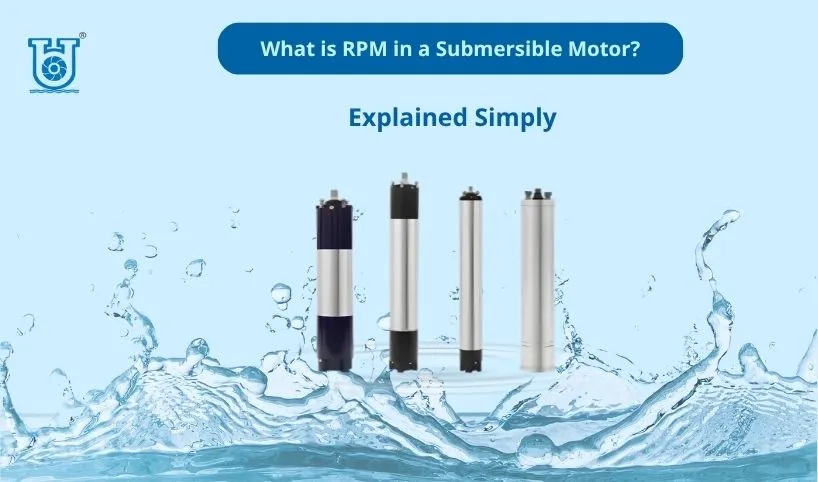
When we buy a submersible pump, we come across the term ‘RPM’ that is mentioned in the motor specifications of the pump manual. Many buyers cannot understand the meaning of this term, and they consider it a technical matter. However, the details of RPM are very simple, and anyone can understand it without studying deeply into the mechanisms of submersible pumps. In this article, significant information regarding RPM is explained to make this term easy for all submersible pump users.
Meaning of RPM
The term RPM stands for ‘Revolutions Per Minute’. It means the number of times the pump motor shaft rotates in one minute. So, RPM is the rotational speed of the motor that drives the impellers of a submersible pump. When RPM is higher, the impellers of that pump can move out water much faster. In short, RPM states how fast the pump motor is moving.
Importance of RPM in A Submersible Pump
RPM is directly responsible for determining the performance of a submersible pump. It affects the water flow rate, energy consumption, efficiency of the motor, generation of water pressure, and wear and tear of motor components. If a pump with the wrong RPM is chosen, it will lead to less output of water, higher use of electricity, and reduced longevity of the submersible pump.
1. Water flow rate
If the RPM of a submersible pump is higher, that means its motor can move out more water very quickly compared to other pumps with lower RPM. So, when water needs to be pumped out very fast, a submersible pump with a high RPM should be bought. On the other hand, slow and steady water flow is available from a pump with a low RPM. Therefore, farmers prefer to buy submersible pumps with high RPMs to irrigate their lands.
2. Water pressure
When the rotational force of the pump motor is higher, the centrifugal force inside the pump increases to a large extent, resulting in pushing out water to a great height. So, submersible pumps with a high RPM are used to draw water from deep borewells, pump water in high-rises, and water supply systems in large industries.
3. Electrical energy consumption
A pump motor with high RPM may consume more electricity, which depends on the application and load exerted on that submersible pump. A motor running at a high speed can deliver more water very quickly. But such a pump is useful only when that speed matches the requirement of the buyer. Therefore, it is essential to buy an energy-efficient submersible pump with a suitable RPM.
4. Production of more heat
When RPM is higher, the motor rotates faster to produce a larger amount of heat. However, submersible pumps of good quality are provided with cooling mechanisms to manage this heat production while operating at a high speed below water. But if the pump is overworked, the motor may be damaged due to too much heat.
5. Lifespan of a submersible pump
If a submersible pump with a high RPM is chosen, it may cause higher mechanical stress, and rapid vibration may result in faster damage to the impellers or wear and tear of the bearings. So, unless really needed, a pump with a lower RPM is a better choice for most applications. Due to low RPM, the pump motor runs more smoothly and renders a higher durability to the submersible pump. Hence, buyers should select the pumps with the correct RPM, as higher RPM than needed may reduce the longevity of their pump motors.
6. Local electrical standard
The RPM of a pump motor is directly connected to the local power grid. In India, 50 Hz power is usually available in all power grids. So, standard submersible pump motors can rotate at 1450 RPM or 2900 RPM to fulfill all the requirements of pump buyers. RPM should be higher at places where power grids experience 60 Hz power, like the USA.
Differences between 1450 RPM and 2900 RPM Motors
1450 RPM motors are commonly known as slow-speed motors, while 2900 RPM motors are the high-speed motors for submersible pumps in India.
Benefits of 1450 RPM motors –
- Less vibration
- Decrease in wear and tear
- Better longevity of the motor
- Suitable for continuous function
Application of 1450 RPM –
- Industrial water supply
- Heavy-duty pumping
Benefits of 2900 RPM –
- Large quantities of water are moved
- Compact design of the pump
- Generation of more pressure
Application of 2900 RPM –
- Deep borewells
- Irrigation
- Quick transfer of water
How to Select the Submersible Pump with the Right RPM?
Since high-speed and low-speed submersible pumps with 2900 RPM and 1450 RPM are available, buyers need to know the factors to choose the right pumps to meet their requirements.
Measure the depth of the borewell
Very deep borewells need submersible pumps with high RPM to generate high water pressure for moving water. Pumps with low RPM can be used in wells having medium depth, as low water pressure is sufficient there.
Determine the water requirement
If the buyer needs to move a large quantity of water, a pump motor of high RPM should be chosen. The pumps with low RPM are suitable for moving a moderate quantity of water at a steady pace.
Check the availability of electricity
If a place experiences fluctuations in voltage, it is best to choose submersible pump motors that are sturdy and more efficient. Some protection systems for the motors can be used as well. Voltage stability is essential for the smooth and safe operation of a submersible pump.
Compatibility of the pump and its motor
The impellers of the submersible pump should be compatible with the motor RPM. So, it is best to consult experts before buying a submersible pump with a suitable RPM. Pump manufacturers or experienced pump technicians can also guide customers in choosing the most suitable pump with the right RPM.
Conclusion
Understanding the difference between various RPM motors allows users to select a submersible pump that best matches their water requirements. The right choice can improve pumping efficiency, reduce power consumption, and minimize maintenance over time. With a focus on quality, innovation, and reliability, Unnati Pumps provides a wide selection of submersible pumping solutions tailored to the needs of farmers, homeowners, and industries.