

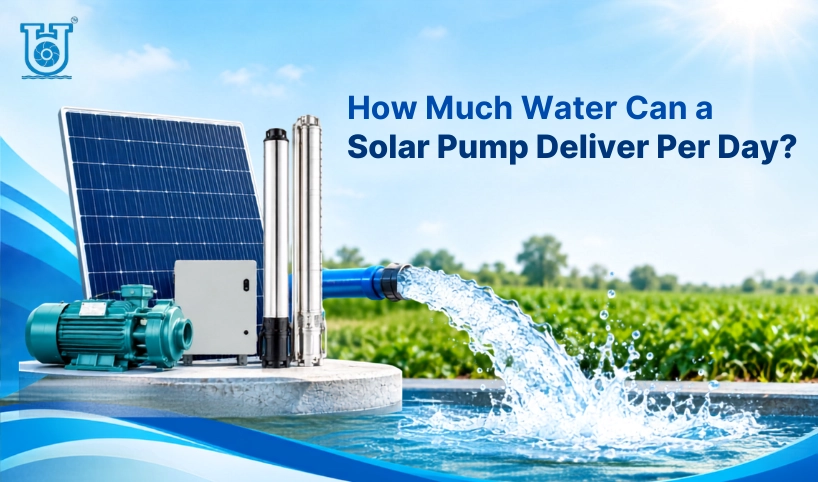
Solar water pumps are becoming a practical choice for farms, rural water supply, livestock watering, and other locations where grid electricity is limited or expensive. But before choosing a system, there is one important question: How much water can a solar pump deliver per day?
The answer depends on the pump model, available sunlight, pumping head, water source, solar panel capacity, and system design. A small solar pump may deliver a few thousand litres per day, while a larger system can deliver hundreds of thousands of litres under suitable operating conditions.
Understanding these factors will help you estimate your daily water requirement and select the right solar water pump for your application.
How is solar pump water output measured?
Solar pump output is usually expressed as litres per hour (LPH), litres per minute (LPM), cubic metres per hour (m³/h), or litres per day (LPD).
For example, if a pump delivers 10,000 litres per hour and operates effectively for 6 hours, its theoretical daily output would be:
10,000 litres/hour × 6 hours = 60,000 litres/day
However, this is only a simple calculation. Actual output can change during the day because the amount of solar energy available is not constant.
Solar panels normally produce less power early in the morning and late in the afternoon compared with the middle of a clear sunny day. Weather, season, panel orientation, and shading can also affect the energy available to the pump.
How much water can a solar pump deliver in a day?
There is no single daily output figure that applies to every solar pump.
The amount of water delivered can range from a few thousand litres to several hundred thousand litres per day, depending on the system.
For example, Unnati Pumps offers different solar pumping systems for different requirements. Its DC solar submersible pump range is designed for approximately 5,000 to 120,000 litres per day, depending on the model and operating conditions. Larger AC solar submersible systems are available for much higher flow requirements.
The right question, therefore, is not simply how much water a solar pump can deliver. It is how much water the selected solar pump can deliver under your specific site conditions.
What affects the daily water output of a solar pump?
Several factors work together to determine how much water you can pump each day.
-
Available sunlight
Solar pumps depend mainly on the energy produced by solar panels. Strong, clear sunlight generally allows the system to operate closer to its expected performance.
On cloudy days or during periods of weak sunlight, less solar energy reaches the system. This may reduce the pump speed, operating time, or total daily water output.
Unnati solar pumping systems can work for around 6 to 8 hours per day under clear sunlight, depending on the system and conditions.
-
Total pumping head
Pumping head is one of the most important factors in pump selection.
It is not simply the depth of the borewell. The calculation can also include the vertical distance the water must travel, the required delivery height, water level, and losses in the pipe and fittings.
A pump usually has to work harder as the total head increases. As a result, the same pump may deliver more water at a lower head and less water at a higher head.
If you use groundwater, understanding how deep a solar pump can lift water can help when planning your system.
-
Pump size and capacity
Solar pumps are available in different power ratings, flow ranges, and designs.
A pump for a small farm or livestock water tank will not have the same capacity as a system designed to irrigate a large agricultural area.
Selecting a larger pump does not automatically guarantee better results. The pump must match the required flow, head, water source, pipe size, and available solar power.
-
Solar panel capacity
The solar array needs to provide enough power for the pumping system.
If the solar panels are undersized, the pump may not receive enough energy to achieve the expected performance. Correct panel sizing is therefore important when designing a solar pumping system.
Panel condition also matters. Dust, dirt, shading, poor positioning, or damage can reduce solar generation and affect daily pumping performance.
-
Water level and water source
The available water source can limit output even when the pump itself has enough capacity.
For a borewell, the static water level and pumping water level should be considered. If the water level falls significantly while pumping, the system may have to lift water from a greater depth.
The water source should also be able to recover fast enough to support the required pumping rate. Pumping more water than a borewell can provide may cause dry-running conditions.
-
Pipe size and friction loss
Water loses pressure as it moves through pipes, bends, valves, and fittings.
Long pipelines, narrow pipes, or too many bends can increase friction loss. This means the pump has to use more energy to move the same amount of water.
Correct pipe sizing can help reduce unnecessary losses and improve overall system performance.
How do you estimate the solar pump capacity you need?
Start with your daily water requirement rather than choosing a pump based only on HP or kW.
Suppose a farm requires 60,000 litres of water per day and receives around 6 effective pumping hours.
The basic required average flow would be:
60,000 ÷ 6 = 10,000 litres per hour
This gives you a starting point, but it is not enough to select the final pump.
You also need to consider the total pumping head, borewell depth, dynamic water level, pipe length, pipe diameter, irrigation method, available sunlight, and solar array capacity.
This is why two farms requiring the same 60,000 litres per day may need different pumping systems.
Can a solar pump provide enough water for irrigation?
Yes, a correctly sized solar pump can be used for many agricultural irrigation requirements.
Solar pumping systems can support drip irrigation, sprinkler irrigation, traditional field irrigation, livestock watering, and storage tank filling.
For farms, it is useful to calculate how much water the crop requires and how frequently irrigation is needed. The required volume can then be compared with the expected daily output of the pumping system.
Solar pumps are particularly useful in remote agricultural areas where grid electricity is unreliable or unavailable. Unnati Pumps provides pumping solutions for agriculture for different water sources and operating requirements.
Should you pump directly or store water in a tank?
Water storage can make a solar pumping system more flexible.
Instead of depending on the pump to supply water exactly when it is needed, the system can pump water into a storage tank during sunny hours. The stored water can then be used later for irrigation, livestock, or other requirements.
This approach can be especially useful when water is needed early in the morning, in the evening, or at times when solar energy is low.
The storage tank should be sized according to daily water demand, pumping capacity, and the amount of backup water required.
AC or DC solar pump: does it affect water output?
Both AC and DC solar pumps can provide effective water supply when they are correctly selected.
The best option depends on the required flow, pumping head, system size, power arrangement, and application. DC systems can be suitable for many off-grid requirements, while AC solar pumping systems are available for applications requiring higher capacities and heads.
If you are comparing the two technologies, read our guide on the differences between AC and DC solar submersible pumps.
How can you get better daily output from a solar pump?
Good system design is just as important as the pump itself.
Keep solar panels clean and free from shade. Make sure the panels are correctly positioned and the pump is matched to the available solar capacity. Use the correct pipe diameter and avoid unnecessary bends or restrictions in the pipeline.
It is also important to monitor the water level and maintain the pump, controller, panels, cables, and other system components according to the manufacturer’s recommendations.
A properly selected and maintained system can provide more consistent performance throughout its working life.
Choosing a solar pump based on daily water requirements
So, how much water can a solar pump deliver per day?
The answer can range from a few thousand litres to hundreds of thousands of litres. There is no universal number because solar pump output depends on the pump capacity, total head, sunlight, solar panel capacity, water availability, pipe design, and operating time.
Before selecting a pump, first determine how much water you need each day and where the water needs to be delivered. Then calculate the head and other site conditions.
Unnati Pumps manufactures DC solar submersible pumps, AC solar submersible pumps, and surface solar pumping solutions for agriculture, rural water supply, and off-grid applications.
Selecting the right system based on actual water demand can help you achieve reliable daily output without oversizing or undersizing the pump.
Frequently asked questions
1. How many litres of water can a solar pump deliver per day?
A solar pump can deliver anywhere from a few thousand to several hundred thousand litres per day, depending on its capacity, pumping head, available sunlight, water source, and system design.
2. How many hours can a solar water pump run per day?
Operating time depends mainly on available sunlight and system design. Under clear sunny conditions, many solar pumping systems can operate effectively for several hours during the day.
3. Does a solar pump work on cloudy days?
A solar pump may continue operating when solar radiation is available, but its performance can be lower than on a clear sunny day. Actual output depends on the solar panels, controller, pump, and intensity of available sunlight.
4. Does borewell depth affect solar pump water output?
Yes. As the required pumping head increases, the pump generally needs more energy to lift water. Flow can therefore decrease as the total head increases.
5. How do I calculate the solar pump size I need?
First calculate your daily water requirement. Then consider the required flow rate, total pumping head, water level, pipe length and diameter, available sunlight, and solar panel capacity. A pump should be selected using all these factors rather than HP alone.
6. Can a solar pump fill a water storage tank?
Yes. A solar pump can pump water into a storage tank during daylight hours. The stored water can then be used when required, including when sunlight is low or unavailable.